


It’s Worth the Drive – S3E3: Breaking the Circuit
Episode 3 – Breaking the Circuit
The Story Continues…
The cover comes off with a gentle snap.
Rows of fuses sit neatly arranged, colorful and orderly.
“They look tiny,” Bentley says.
Her grandpa nods. “They are. But they’re stubborn.”…
The Smallest Parts That Prevent the Biggest Problems
As automobiles evolved from purely mechanical machines into electrically dependent systems, one quiet component became essential: the fuse. While engines and batteries tend to capture attention, fuses perform one of the most critical roles in any vehicle—protecting wiring, electronics, and safety systems from electrical failure.
From early lighting circuits to today’s computer‑controlled vehicles, automotive fuses have quietly evolved alongside the electrical systems they protect.
Why Vehicles Need Fuses at All
Automotive electrical systems operate within tightly defined limits. Every wire, switch, motor, and control module is designed to handle a specific amount of current. When something goes wrong—a short circuit, damaged wire, or failed component—current can spike beyond safe limits.
A fuse provides a deliberate weak point in the circuit. If current exceeds a safe threshold, the fuse sacrifices itself by melting its internal element, instantly opening the circuit and stopping electrical flow before damage occurs.
Without fuses, electrical problems could happen quickly:
- overheat wiring
- damage control modules
 cause fires
- disable critical safety systems
The Early Days: Glass Tube Fuses
The earliest automotive electrical systems were modest—headlights, ignition coils, and basic accessories—but even these systems required protection.
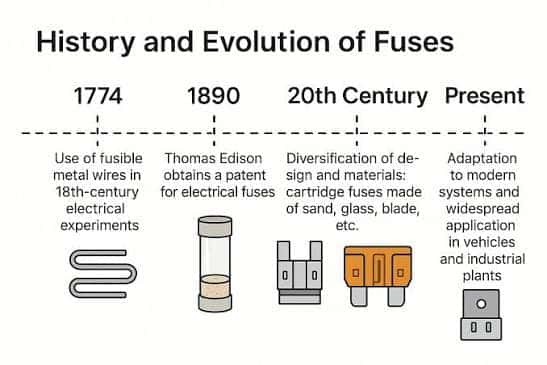
Glass tube fuses were the first widely used automotive fuse design. They consisted of a thin metal wire sealed inside a transparent glass tube. If current exceeded the rating, the wire melted and broke the circuit.
While effective, glass fuses had drawbacks:
- fragile construction
- poor vibration resistance
- difficult removal
- hard‑to‑read amperage markings
As vehicles grew more complex, these limitations became unacceptable.
Blade Fuses: A New Standard Emerges
The shortcomings of glass fuses led to the development of the blade fuse, which became the automotive industry standard in the late 20th century.
Blade fuses feature:
- a plastic body
- two exposed metal prongs
- an internal fusible link
- standardized sizes and amperage ratings
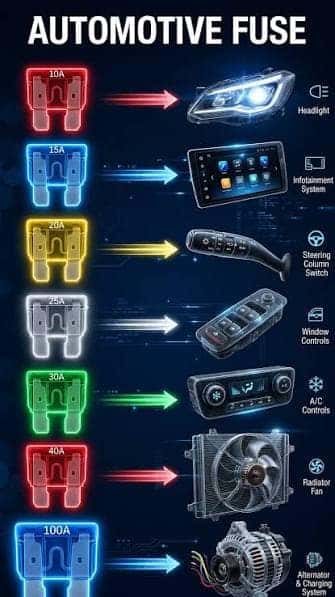
One of their most important improvements was color coding, allowing immediate identification of amperage ratings without reading tiny numbers. Blade fuses were more durable, easier to replace, and better suited to modern fuse boxes.
They remain the most common form of fuse in vehicles today.
Smaller Vehicles, Smaller Fuses
As electronics became more prevalent, packaging space inside vehicles grew tighter. The response was mini and micro blade fuses—smaller designs that provide the same protection in a reduced footprint.
These compact fuses allow:
- higher fuse density
- more circuits per vehicle
- protection of sensitive electronics
They are now commonly used in:
- electronic control units (ECUs)
- infotainment systems
- safety sensors
- body control modules
The Fuse Box: Power Distribution Headquarters
As fuse technology improved, so did the way vehicles managed electrical power.
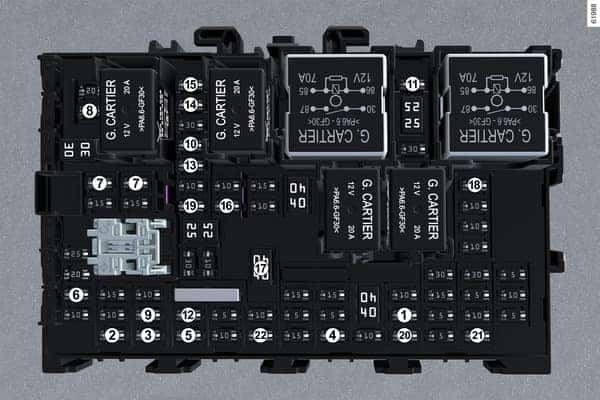
The fuse box—often called a power distribution center—organizes fuses and relays in a single location, channeling electrical power from the battery and alternator to every system in the vehicle.
Most modern vehicles use multiple fuse boxes:
- Engine bay fuse box for high‑current systems
- Interior fuse box for accessories and convenience systems
- Rear or auxiliary panels for specialized equipment
This layered design simplifies diagnostics while preventing cascading failures.
Fuses vs. Relays: Different Jobs, Same Goal
While fuses protect circuits, relays control them.
A relay uses a low‑current signal to switch a high‑current circuit on or off, protecting switches and control modules from heavy electrical loads. Cooling fans, fuel pumps, starters, and horns rely on relays working alongside fuses.
Together, fuses and relays form the backbone of electrical safety and control in modern vehicles.
From Melted Wire to Microchips: Smart Circuit Protection
As vehicles entered the digital age, traditional fuses began sharing space with solid‑state protection devices, sometimes called smart fuses.
These electronic protectors:
- sense overcurrent conditions instantly
- shut down circuits electronically
- can reset automatically
- provide diagnostic feedback
Rather than simply blowing and requiring replacement, these systems communicate faults to vehicle computers—helping technicians pinpoint problems faster.
Electric Vehicles Change the Equation
The rise of electric vehicles pushed fuse design even further.
EVs operate at much higher voltages and currents than traditional 12‑volt systems. Battery packs, inverters, and electric motors require:
- high‑voltage fuses
- fast‑acting protection
- arc‑suppression capabilities
Failure in these systems is not just inconvenient; it’s dangerous. Specialized EV fuses are designed to interrupt immense electrical loads safely, protecting both the vehicle and its occupants.
Why Fuses Still Matter More Than Ever
Despite growing sophistication, the fuse remains a simple idea with enormous consequences. As vehicles add:
- advanced driver assistance systems
- digital dashboards
- electrified powertrains
- connected technology
The need for precise, reliable circuit protection only increases.
A $3 fuse still protects components costing thousands.
Why It Still Matters at Mills Auto Group
Modern vehicles depend on electrical systems more than at any point in history. From climate control and infotainment to safety systems and propulsion, everything begins and ends with properly managed electrical power.
At Mills Auto Group, being Trusted for Generations means helping customers understand not just visible features, but the unseen systems that keep vehicles safe and reliable. Automotive fuses—small though they may be—play a critical role in protecting the technology drivers rely on every day.
From glass tubes to smart protection systems, the evolution of the fuse mirrors the evolution of the automobile itself: simple beginnings, steady refinement, and constant adaptation to new demands.
Closing Scene..
…They replace a blown fuse together.
Bentley presses it in carefully, as if it might feel pain.
“So they break to protect everything else?” she asks.
He nods. “Taking one for the team.”
She decides she likes that idea.
To Be Continued…
 Alvarado, Gregory. “The Evolution of Car Fuses: A Safety Revolution.” Autoescuelas.net, 2 Mar. 2025, www.autoescuelas.net/the-evolution-of-car-fuses-a-safety-revolution/. Accessed 27 Apr. 2026.
Cope, Liam. “What Is a Fuse Box in a Car and How Does It Work?” Engineer Fix, 6 Jan. 2026, engineerfix.com/what-is-a-fuse-box-in-a-car-and-how-does-it-work/#google_vignette. Accessed 27 Apr. 2026.
Repairs Advisor Team. “How Does Your Car’s Fuse Box Work?” Repairs Advisor, 28 May 2025, repairsadvisor.com/blog/how-does-your-cars-fuse-box-work/. Accessed 27 Apr. 2026.









0 comment(s) so far on It’s Worth the Drive – S3E3: Breaking the Circuit