


It’s Worth the Drive – S4E2: Twisted Power
Episode 2 – Twisted Power
The Twist That Moves the Car
Opening
They pull onto a long incline.
Bentley feels the push into her seat as the car climbs smoothly. “That feeling,” she says. “That’s different.”
Her grandpa nods. “That’s torque.”
He describes twisting force, how power matters—but getting moving matters more.
Horsepower Gets the Headlines
Ask most people about vehicle performance, and they will immediately talk about horsepower.
Manufacturers advertise it.
Enthusiasts compare it.
Racetracks celebrate it.
But while horsepower often receives the attention, torque is the force that actually gets a vehicle moving.
Without torque, horsepower would be meaningless.
Every time a vehicle accelerates from a stoplight, climbs a hill, pulls a trailer, or crawls over an off-road obstacle, torque is doing the heavy lifting.
The history of the automobile cannot be fully understood without understanding torque.
The Meaning of Torque
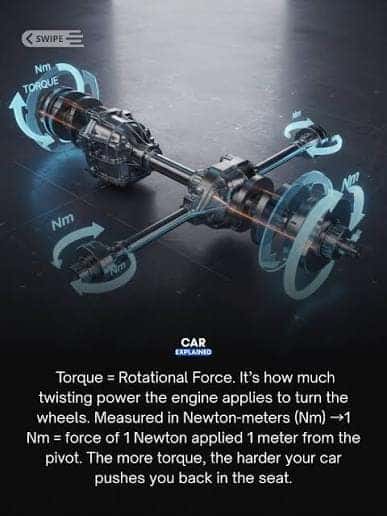
The word torque comes from the Latin word torquere, meaning “to twist.”
Long before automobiles existed, engineers understood that rotational force could accomplish work more efficiently than simple linear motion.
Torque is not speed.
Torque is not horsepower.
Torque is a twisting force applied around a central axis.
Anyone who has used a wrench has applied torque. The longer the wrench, the easier it becomes to apply force and turn the bolt.
The same principle exists inside every engine.
Turning Explosions into Motion
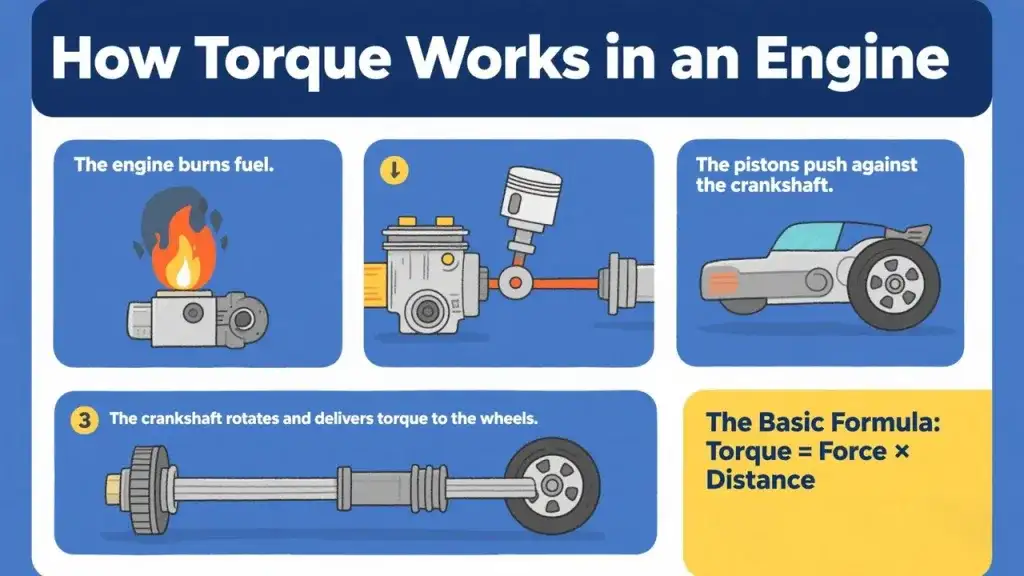
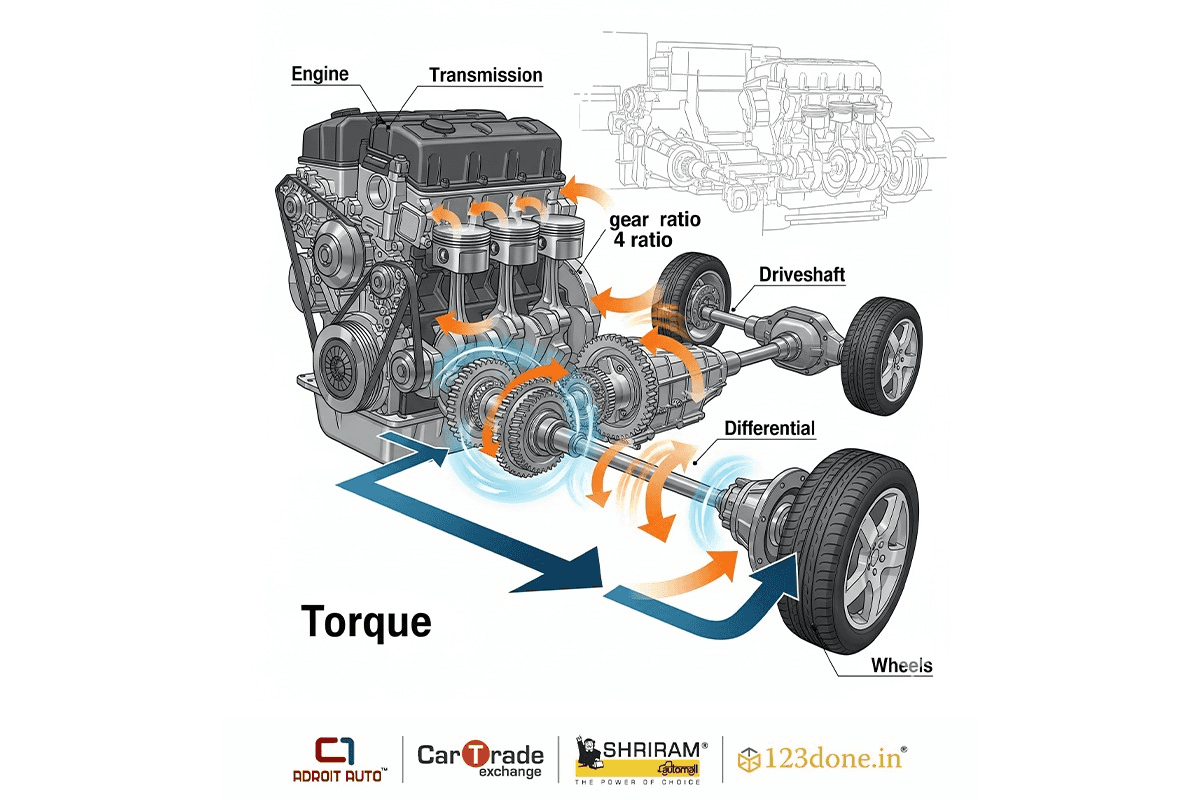
An internal combustion engine creates power through thousands of controlled explosions every minute.
Inside each cylinder:
- Fuel and air are compressed
- The mixture ignites
- The expanding gases force a piston downward
The piston itself only moves in a straight line.
To drive a vehicle, that linear motion must be converted into rotational motion.
This happens through the crankshaft.
As each piston pushes downward, it turns the crankshaft and creates a twisting force.
That twisting force is torque.
Without torque, the engine’s combustion process would never move the vehicle.
Torque Before the Automobile
The concept of torque existed long before automobiles appeared.
Ancient civilizations unknowingly used torque whenever they:
- Turned wheels
- Operated windmills
- Raised water with mechanical devices
- Used levers to move heavy objects
The Industrial Revolution dramatically increased the importance of rotational power.
Factories relied on rotating shafts driven by:
- Water wheels
- Steam engines
- Belt-driven machinery
Engineers recognized that understanding twisting force was critical to understanding mechanical power.
The Scientific Birth of Torque
The term itself entered engineering language during the nineteenth century.
The word “torque” was first formally introduced by engineer James Thomson in 1884.
Before that, engineers commonly referred to rotational force as a “moment of force.”
Thomson believed torque better described the twisting action occurring within mechanical systems.
As engines, turbines, and machinery became more sophisticated, torque became one of the fundamental measurements used by engineers worldwide.
The Arrival of the Automobile
When automobiles emerged during the late nineteenth century, torque immediately became important.
Early engines produced very little horsepower by modern standards.
What mattered was their ability to generate enough twisting force to:
- Start moving
- Climb hills
- Carry passengers
- Overcome rough roads
Many early vehicles produced modest horsepower figures but significant low-speed torque relative to their size.
In an era before paved highways, torque often mattered more than top speed.
Torque and the Rise of Trucks
As commercial transportation developed, torque became increasingly valuable.
Farmers, contractors, and businesses required vehicles capable of hauling heavy loads.
Moving weight requires force.
The greater the load, the greater the torque required to get it moving.
This reality drove the development of:
- Larger engines
- Heavier crankshafts
- Longer engine strokes
- Diesel powerplants
High-torque engines became the backbone of commercial transportation.
Why Diesel Engines Became Torque Kings
Few technologies shaped torque development more than the diesel engine.
Invented by Rudolf Diesel in the 1890s, diesel engines operate differently than gasoline engines.
Their design naturally encourages:
- Higher cylinder pressures
- Longer strokes
- Greater low-speed pulling power
As a result, diesel engines typically produce enormous torque at relatively low engine speeds.
This characteristic made them ideal for:
- Trucks
- Buses
- Construction equipment
- Agricultural machinery
To this day, diesel engines remain synonymous with torque.

Torque vs. Horsepower
One of the most misunderstood topics in automotive history is the relationship between torque and horsepower.
Simply put:
Torque
Measures twisting force.
Horsepower
Measures how quickly work is being done.
A useful comparison is:
- Torque is strength.
- Horsepower is speed.
A strong person can push a heavy object.
A fast person can move it quickly.
In engineering terms, horsepower is calculated using torque and engine speed.
The relationship is expressed as:
Horsepower = (Torque × RPM) ÷ 5,252
This explains why high-performance engines often focus on both measurements rather than one alone.
The Muscle Car Era
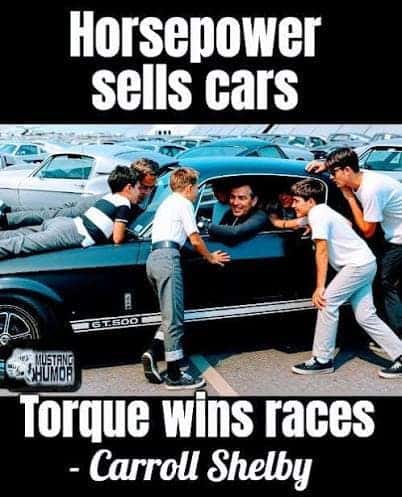
Torque became a household term during the American muscle car era of the 1960s and 1970s.
Manufacturers competed to build engines that delivered:
- Massive displacement
- Incredible acceleration
- Tire-spinning performance
Many famous muscle cars generated tremendous torque at low engine speeds.
Drivers felt that force immediately when pressing the accelerator.
The sensation of being pushed back into the seat became one of the most celebrated aspects of American performance vehicles.
Torque Shapes Driving Feel
Different engines can produce dramatically different driving experiences depending on how torque is delivered.
High-Torque Engines
Feel powerful immediately.
They excel at:
- Towing
- Hauling
- Hill climbing
- Low-speed acceleration
High-RPM Engines
Often build power gradually and perform best at higher speeds.
Many sports cars sacrifice low-end torque in favor of higher horsepower near the top of the RPM range.
Neither approach is inherently better—each serves a different purpose.
Modern Technology Changes Torque Delivery
Advances in engineering have dramatically transformed torque production.
Technologies such as:
- Turbocharging
- Supercharging
- Variable valve timing
- Direct fuel injection
allow smaller engines to produce torque levels once reserved for much larger powerplants.
Today’s four-cylinder engines frequently generate more torque than V8 engines from previous generations.
This has improved:
- Fuel economy
- Emissions
- Drivability
- Overall performance
The Electric Vehicle Revolution
Electric vehicles have fundamentally changed the conversation around torque.
Unlike internal combustion engines, electric motors produce maximum torque almost instantly.
The moment the accelerator is pressed, full twisting force becomes available.
This characteristic helps explain why many electric vehicles accelerate so quickly despite having fewer moving parts than traditional engines.
In some respects, electric vehicles represent the ultimate torque machines.
They deliver immediate force without waiting for engine speed to build.
Why Torque Still Matters Today
Although horsepower often dominates advertisements and marketing campaigns, torque remains one of the most important measurements in vehicle performance.
It determines how effectively a vehicle can:
- Accelerate
- Tow
- Haul
- Climb
- Respond to driver input
Whether powered by gasoline, diesel, hybrid systems, or electricity, every vehicle relies on torque to transform energy into motion.
The method may have changed, but the principle remains the same.
Why It Still Matters at Mills Auto Group
Torque may not generate the same attention as horsepower, but it is the force drivers experience every time they accelerate, pull a trailer, climb a hill, or navigate challenging road conditions. Understanding torque helps explain why different vehicles perform differently and why certain engines are better suited for specific tasks.
At Mills Auto Group, being Trusted for Generations means helping customers understand the technology behind the vehicles they drive. Whether choosing a truck for towing, an SUV for family travel, a sports car for performance, or an electric vehicle for efficiency, torque plays a major role in how that vehicle feels and performs.
For more than a century, automotive engineers have worked to harness, refine, and improve torque delivery. It remains one of the most fundamental forces in transportation—a twisting force that quietly turns engines, spins wheels, and keeps the world moving forward.
Closing
Bentley watches the road crest ahead.
“So torque is what gets you going,” she says, “and horsepower is how long you can keep it up.”
He smiles. “You’re ahead of the curve already.”
 CarHQ. “What Is Torque and Why Does It Matter? Understanding Torque in Cars.” 18 Aug. 2025.
Cope, Liam. “What Is Torque in Cars and Why Does It Matter? – Engineer Fix.” Engineer Fix, 9 Jan. 2026, https://engineerfix.com/what-is-torque-in-cars-and-why-does-it-matter/. Accessed 27 July 2026.
https://web.facebook.com/profile.php?id=100006573302051. “How Torque Works in a Car Engine – a Complete Guide.” 12 July 2025.










0 comment(s) so far on It’s Worth the Drive – S4E2: Twisted Power