


It’s Worth the Drive – S4E1: Galloping Gains
Episode 1 – Galloping Gains
SEASON 4 — OPENING
The Road, A Little Longer Now
The highway stretches ahead in a clean, unbroken line.
Bentley sits taller in the passenger seat now, one knee pulled up slightly, window half open. Wind slips in and tugs at her hair as fields and trees pass in a steady rhythm.
Her grandpa keeps one hand on the wheel, relaxed. This road isn’t new to him—but it feels different today.
She breaks the quiet.
“We talked about cars in school today,” she says. “But they used all these words. Numbers. Stuff everyone just nodded at.”
He smiles without looking over.
“Good,” he says. “Means you’re paying attention.”
Opening
Bentley watches the tachometer climb gently as they accelerate.
“So… horsepower,” she says. “There aren’t horses in here. Right?”
Her grandpa laughs. “Not anymore.”
He explains slowly, tying it back to work—lifting, pulling, effort measured over time. Horses replaced muscle. Engines replaced horses. The name stayed…
Before Cars Had Horsepower
Today, horsepower is one of the first numbers people look at when comparing vehicles.
A sports car might boast 500 horsepower. A pickup truck may advertise 400 horsepower. Even electric vehicles continue to quote horsepower figures despite having no engine in the traditional sense.
Yet long before automobiles existed, horsepower was not an engineering measurement at all.
It was a sales tool.
The story begins in the late eighteenth century during the dawn of the Industrial Revolution, when horses remained the world’s most important source of mechanical power.
A World Powered by Horses
For thousands of years, horses powered civilization.
They pulled:
- wagons
- plows
- stagecoaches
- mining equipment
- canal boats
- mill machinery
Businesses understood exactly what a horse could accomplish because they relied on them every day.
If a mine operator needed more work completed, he purchased more horses.
If a farmer wanted to cultivate additional land, he added more horses.
Everyone understood horsepower long before the term officially existed.
James Watt’s Problem
In the 1760s, Scottish inventor James Watt dramatically improved the steam engine.
Earlier steam engines worked, but they were inefficient and consumed large amounts of coal. Watt’s improvements made steam power far more practical and economical.
There was just one challenge.
How do you convince people to buy a machine that nobody understands?
Watt realized his potential customers were not comparing steam engines to other machines. They were comparing them to horses.
To sell steam engines, he needed a way to explain their power using something everyone already understood.
Inventing Horsepower
Watt studied horses working in mills and coal mines.
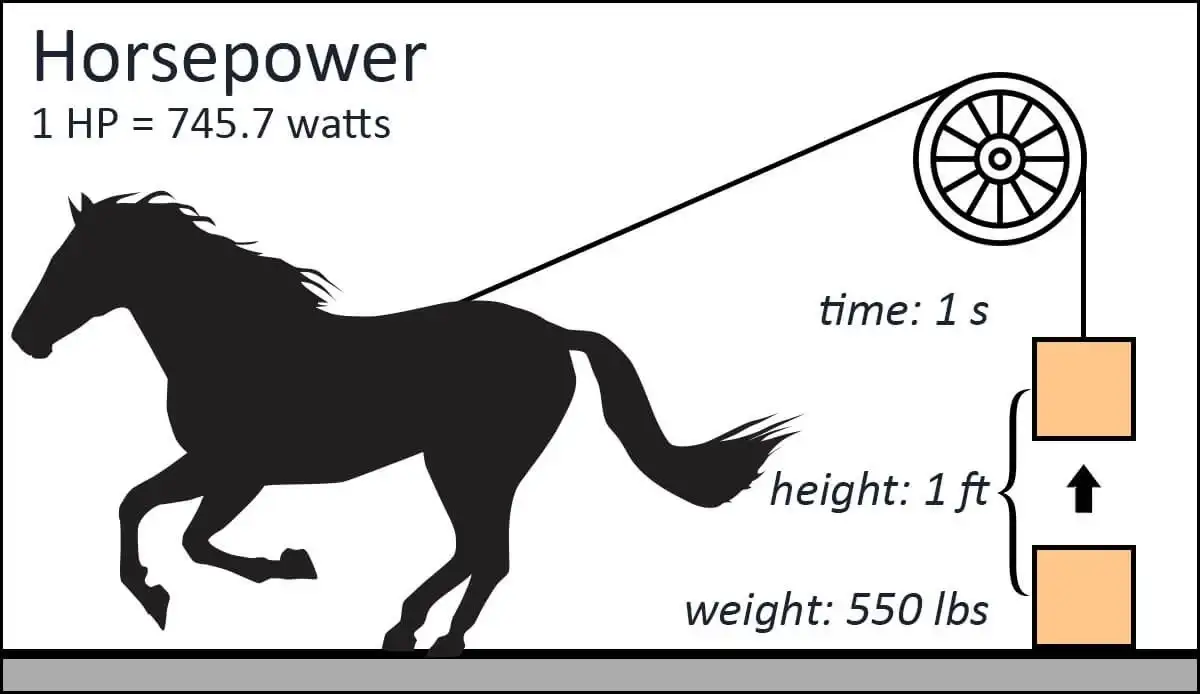
After observing the amount of work an average horse could perform, he developed a simple calculation.
He concluded that one horse could perform:
33,000 foot-pounds of work per minute
In practical terms, this meant lifting:
33,000 pounds one foot in one minute
or
330 pounds 100 feet in one minute.
Watt called this unit:
One Horsepower
The term immediately resonated with customers.
Rather than discussing complicated engineering concepts, Watt could simply tell a customer that his steam engine could do the work of ten horses.
The idea was brilliant.
A Marketing Masterstroke
Horsepower became one of history’s greatest marketing successes.
Customers instantly understood the comparison:
- Five horsepower meant the work of five horses.
- Ten horsepower meant ten horses.
- Twenty horsepower meant twenty horses.
Watt’s invention of the term helped accelerate the adoption of steam engines throughout Britain and eventually the world.
Soon, competing manufacturers began advertising their own engines using horsepower as well.
What began as a sales tool evolved into a universal standard.
Was Watt Correct?
Not exactly.
Watt based much of his work on observations of small mining ponies, sometimes called pit ponies. He then estimated that larger horses could perform approximately 50 percent more work.
Modern research suggests he overestimated the sustained power of an average horse.
Ironically, a healthy horse can often produce more than one horsepower for short bursts of activity and somewhat less than one horsepower during long periods of continuous work.
In other words:
One horse is not necessarily equal to one horsepower.
But by then, the term had already become part of engineering language.
Steam Power Defeats the Horse
The rise of horsepower coincided with one of the greatest transformations in transportation history.
Steam engines rapidly began replacing horse-powered labor.
Nowhere was this more visible than on the railroad.
For centuries, wagons and carts depended on horses. Suddenly, steam locomotives could perform the work of dozens—or even hundreds—of animals.
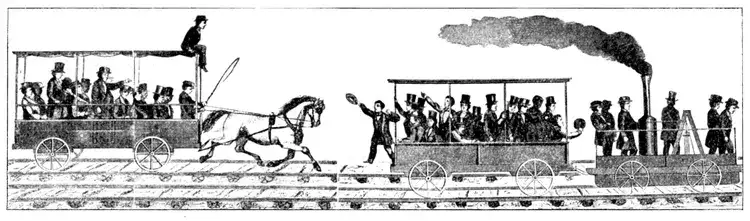
One famous example occurred in 1830 when Peter Cooper’s steam locomotive, the Tom Thumb, challenged a horse-drawn railroad car to a race.
Although mechanical issues prevented the locomotive from winning, the demonstration convinced railroad executives that steam represented the future.
Within a few decades, horse-powered transportation was being replaced throughout much of the world.
Horsepower Enters the Automobile Age
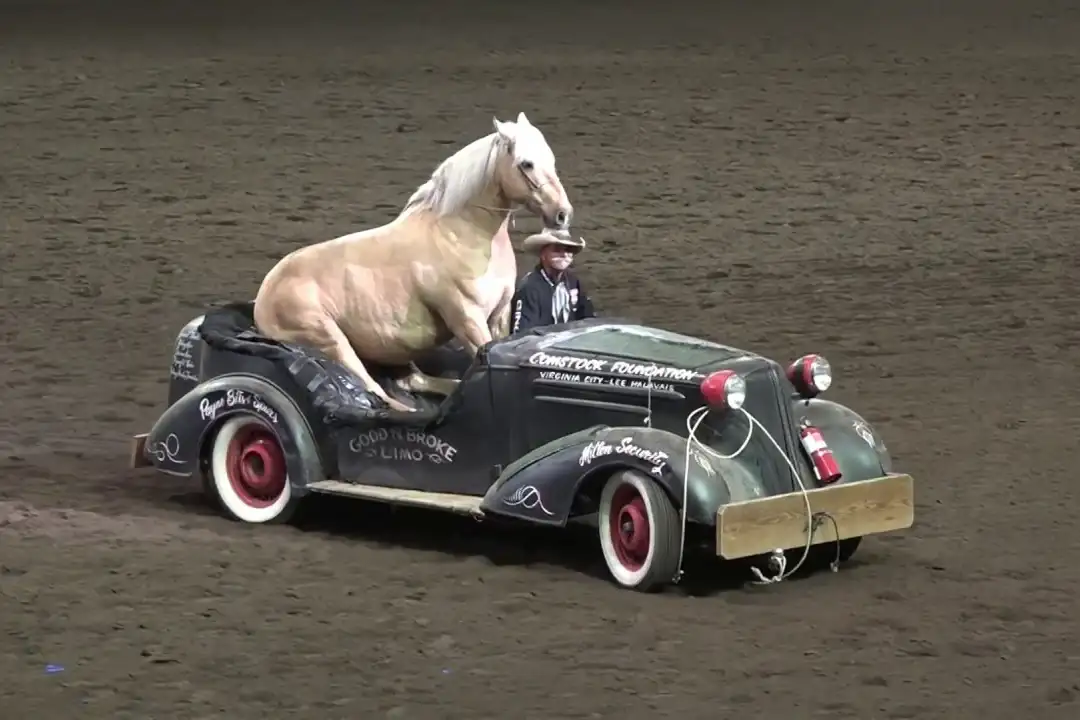
When automobiles appeared in the late nineteenth century, engineers naturally adopted the established horsepower standard.
Early automobiles often produced surprisingly little power by modern standards.
Examples included:
- Benz Patent-Motorwagen: less than 1 horsepower
- Ford Model T: approximately 20 horsepower
- Early luxury cars: 40 to 60 horsepower
At the time, those numbers represented impressive performance.
As engine technology improved, horsepower figures steadily increased.
The Horsepower Wars
By the middle of the twentieth century, horsepower became one of the most important marketing tools in the automotive industry.
Manufacturers competed aggressively to build more powerful engines.
The muscle car era of the 1960s saw legendary horsepower battles among:
- Ford
- Chevrolet
- Dodge
- Plymouth
- Pontiac
Horsepower figures became symbols of performance and prestige.
The higher the number, the faster and more exciting the vehicle appeared.
Even today, enthusiasts continue comparing horsepower numbers as a quick measure of a vehicle’s potential performance.
Horsepower vs. Watts
Ironically, the modern scientific unit used to measure power is named after the very person who invented horsepower.
The watt was named in honor of James Watt in 1882.
The relationship between the two units is:
- 1 horsepower = 746 watts
- 1 kilowatt = approximately 1.34 horsepower
Most countries now use kilowatts as the official measurement of power.
 Yet horsepower remains deeply rooted in automotive culture.
Horsepower in the Electric Vehicle Era
One might assume that horsepower would disappear with the arrival of electric vehicles.
Instead, the opposite has happened.
Manufacturers continue to advertise horsepower because consumers instantly understand it.
For example:
- A Tesla producing 750 kilowatts sounds impressive.
- A Tesla producing over 1,000 horsepower sounds exciting.
The familiar horsepower figure remains an effective way of communicating performance, even when no pistons, camshafts, or transmission gears are involved.
More than two centuries after Watt introduced the term, it remains one of the most recognized measurements in the automotive world.
Why Horsepower Endures
The endurance of horsepower comes from its simplicity.
It provides a common language that allows drivers to compare vehicles across generations.
A modern vehicle may have:
- gasoline power
- diesel power
- hybrid power
- electric power
Yet horsepower remains a familiar benchmark.
Its continued use reflects the remarkable influence of a Scottish inventor who simply wanted customers to understand his product.
Why It Still Matters at Mills Auto Group
Few automotive terms are as universally recognized as horsepower. For more than 250 years, it has served as a way to describe power, performance, and capability. From steam engines and locomotives to muscle cars, pickup trucks, and electric vehicles, horsepower has remained one of the automotive industry’s most enduring measurements.
At Mills Auto Group, being Trusted for Generations means helping customers understand not only today’s vehicles, but also the history behind the technologies and terms that continue to shape the automotive world. Horsepower may have begun as a marketing idea during the Industrial Revolution, but it evolved into a standard that generations of drivers still use to evaluate performance.
The next time you hear a vehicle described as having 200, 400, or even 1,000 horsepower, remember that the measurement traces its roots not to an automobile at all, but to a horse walking in a circle more than two centuries ago. What started as a simple comparison became one of the most famous numbers in transportation history.
Closing Scene…
…Bentley leans back against the seat.
“So it’s not about speed,” she says. “It’s about how much work the engine can do.”
He nods. “That’s exactly it.”
The road hums beneath them, steady and patient.
To Be Continued…

CarWikiHub. “Why Horsepower Remains the Iconic Car Power Metric.” CarWikiHub, 20 Feb. 2026, https://carwikihub.com/blogs/horsepower-history-automotive-power/. Accessed 24 July 2026.
dan-seo. “Don’t Put the Horsepower Before the Horse.” European Auto Specialists, LTD., 8 Mar. 2021, https://euroautospecialists.com/dont-put-the-horsepower-before-the-horse/. Accessed 24 July 2026.
Longley, Robert. “Where Did the Term ‘Horsepower’ Come From?” 3 Sept. 2021.
Ward, James. “The Origin of Horsepower – the True Story Behind the Term Rev-Heads Take for Granted.” Drive, 2 Nov. 2020, https://www.drive.com.au/news/the-origin-of-horsepower-the-fascinating-and-true-story-behind-the-term-rev-heads-take-for-granted/. Accessed 24 July 2026.










0 comment(s) so far on It’s Worth the Drive – S4E1: Galloping Gains