


It’s Worth the Drive – S3E6: Get It Into Gear
Episode 6 – Get It Into Gear
The Story Continues…
Bentley sits on a stool now, swinging her legs while listening.
“This part decides how the power moves,” her grandpa explains.
Why Cars Needed More Than an Engine
The internal combustion engine may provide the power, but without a way to control and multiply that power, an automobile would be difficult to drive and largely impractical. Engines operate within a relatively narrow range of speeds, while vehicles must start from a standstill, climb hills, cruise efficiently, and travel at highway speeds.
The transmission was developed to bridge that gap, controlling how power moves from the engine to the wheels. Over time, it became one of the most complex and important systems in an automobile.
The Earliest Methods of Power Transfer
The first automobiles relied on simple methods such as belts, chains, and pulleys to transfer engine power to the wheels. These systems functioned much like oversized bicycle drivetrains, providing only limited flexibility in speed and torque.
While adequate for low-speed operation, they struggled to deliver both acceleration and top speed. Engineers quickly realized that multiple gear ratios were needed if automobiles were going to become practical for everyday transportation.
The Birth of the Transmission
The next major step was the introduction of enclosed gearboxes containing multiple gears. These early transmissions allowed drivers to select different gear ratios depending on driving conditions.
The concept was simple:
- Lower gears provided more pulling power.
- Higher gears improved speed and efficiency.
- Reverse gearing allowed vehicles to back up.
- Neutral disconnected the engine from the wheels.
This innovation dramatically expanded what automobiles could do and laid the foundation for all future drivetrain development.
Planetary Gears Change the Game
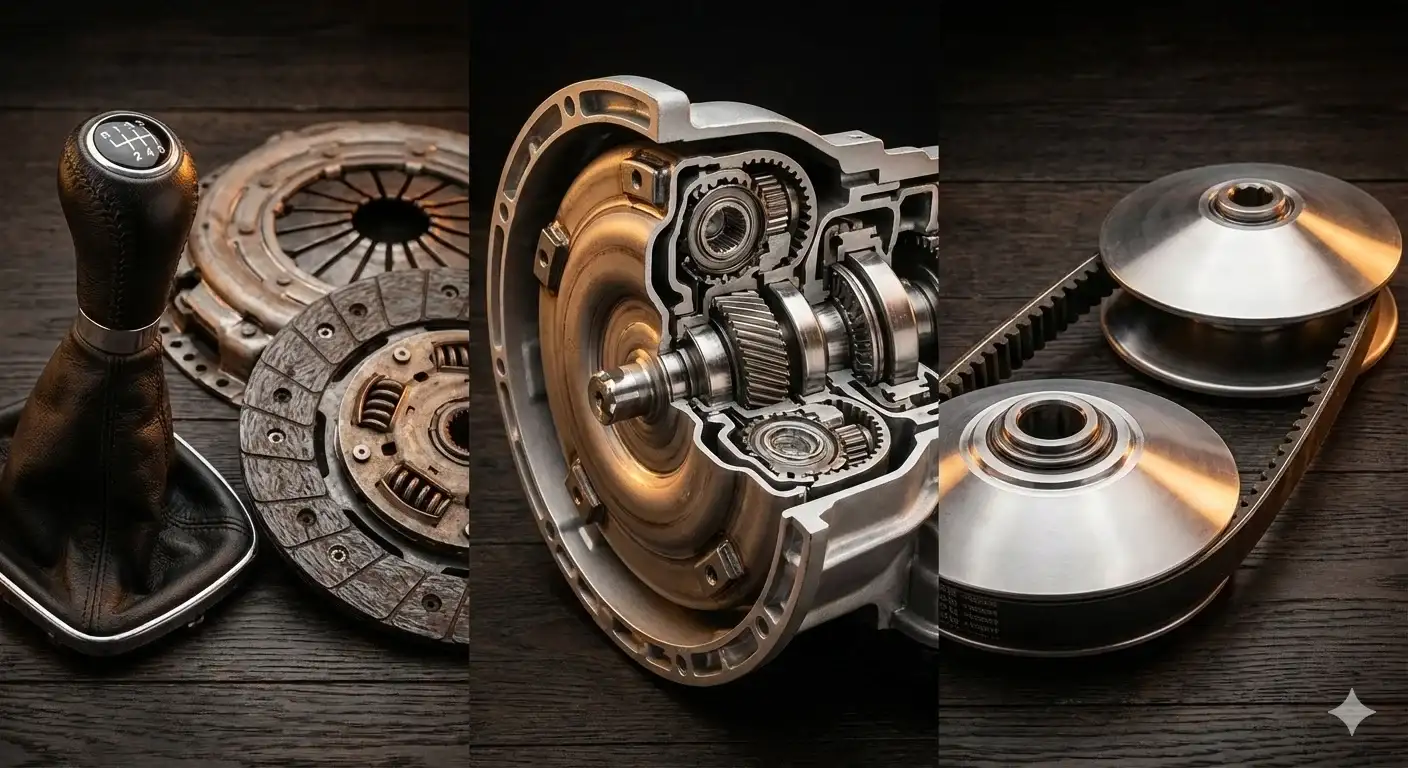
One of the most important innovations in transmission history was the planetary gearset.
Unlike traditional gears arranged on parallel shafts, a planetary gearset consists of:
- a central sun gear
- surrounding planet gears
- a ring gear
- a carrier assembly
By selectively holding or driving different components, a planetary gearset can create multiple gear ratios within a compact package.
The design was revolutionary and remains one of the most important engineering developments in transmission history. Even today, planetary gearsets continue to form the foundation of many modern automatic transmissions.
Making Driving Easier
Early transmissions could be difficult to operate. Shifting required significant driver skill and mechanical understanding. Over time, manufacturers developed improvements that made gear changes smoother and more reliable.
The invention of synchronization mechanisms during the late 1920s was particularly important. These systems automatically matched gear speeds before engagement, eliminating much of the grinding and effort associated with early transmissions.
As a result:
- driving became easier
- wear decreased
- vehicles became more accessible to everyday motorists
The Rise of Automatic Operation
One of the most significant milestones arrived in the late 1930s and early 1940s with the introduction of the first successful mass-produced automatic transmissions.
These systems used:
- hydraulic controls
- planetary gearsets
- clutch packs
- brake bands
to change gears automatically.
For drivers, the benefits were obvious. Vehicles became easier to operate, especially in city traffic. Over the following decades, automatic transmissions steadily gained popularity and eventually became the dominant choice in North America.
The Importance of Transmission Fluid

As transmissions became more sophisticated, a specialized fluid evolved alongside them.
Transmission fluid performs several critical functions:
- lubricates gears and bearings
- removes heat
- prevents corrosion
- reduces wear
- cleans internal components
- provides hydraulic pressure in automatic transmissions
Unlike engine oil, transmission fluid in many automatic transmissions is not merely a lubricant—it is an active working component of the system itself.
Without transmission fluid, the transmission cannot function.
Cooling and Protecting the Transmission
Like engines, transmissions generate significant heat. Friction between gears, clutches, bearings, and rotating components creates temperatures high enough to damage internal parts.
Transmission fluid circulates throughout the system, carrying heat away from critical components and often passing through dedicated transmission coolers.
Modern transmission fluids also contain:
- detergents
- oxidation inhibitors
- anti-foaming agents
- corrosion inhibitors
- friction modifiers
These additives greatly extend the life of modern transmissions and allow today’s units to operate for hundreds of thousands of miles when properly maintained.
The Evolution of Transmission Fluid
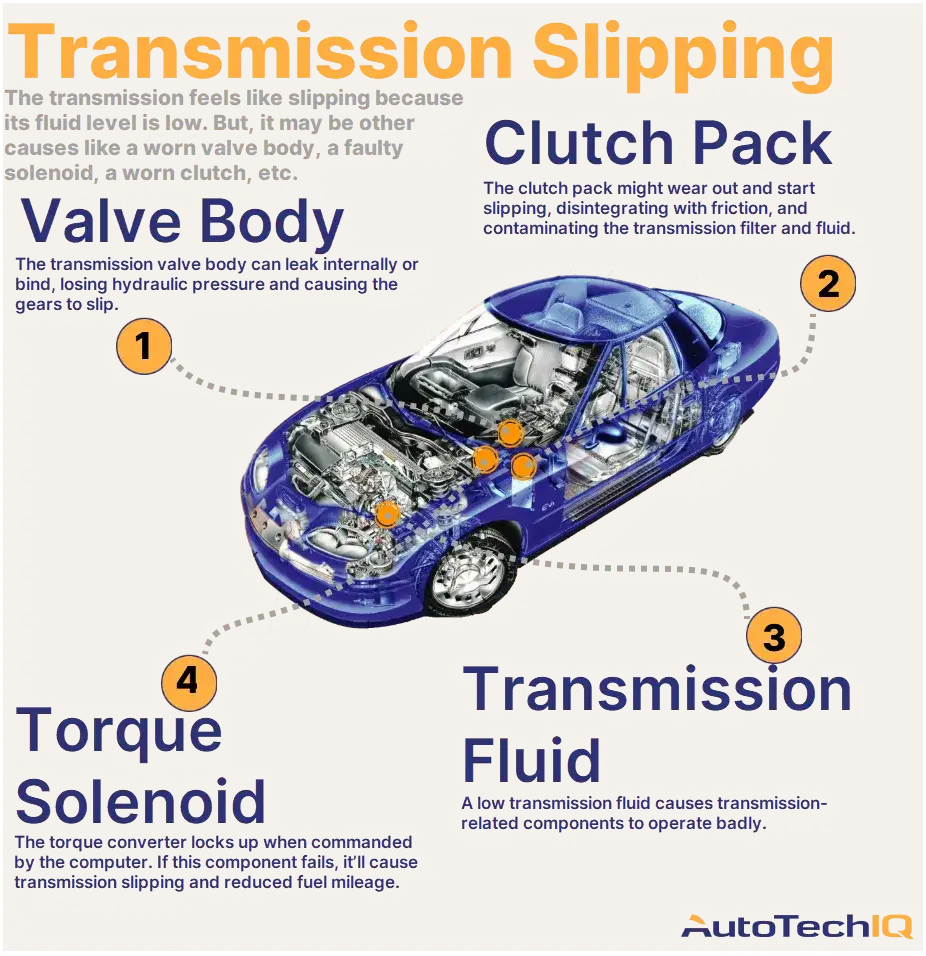
Early transmission lubricants were relatively simple oils. As transmissions grew more advanced, fluid technology evolved to meet new demands.
Different transmission types now require specialized fluids:
Automatic Transmission Fluid (ATF)
Designed to provide hydraulic operation, lubrication, cooling, and controlled friction characteristics.
Manual Transmission Lubricants
Formulated for gear protection and synchronizer operation.
CVT Fluids
Engineered to withstand the unique forces generated by continuously variable transmissions.
Dual-Clutch Transmission Fluids
Developed to support rapid shifting and clutch operation while protecting gears and bearings.
Modern fluids are precisely engineered for specific transmission designs, making the use of the correct fluid more important than ever.
More Gears, Better Efficiency
As fuel economy regulations and consumer expectations increased, manufacturers developed transmissions with more gear ratios.
Where early automobiles often had two or three forward gears, modern vehicles may have:
- six-speed transmissions
- eight-speed transmissions
- nine-speed transmissions
- ten-speed transmissions
Additional gears allow engines to operate closer to their ideal efficiency range, improving both performance and fuel economy.
The Future of Power Delivery
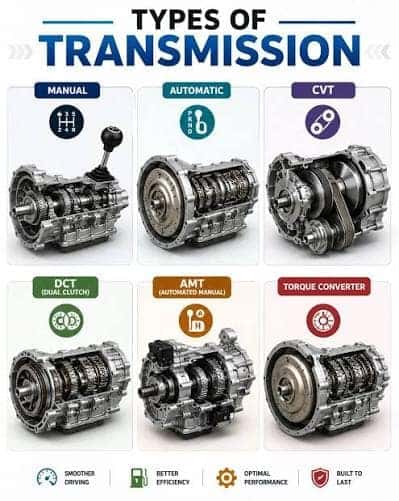
Electric vehicles are once again changing how power reaches the wheels.
Unlike internal combustion engines, electric motors produce strong torque across a broad operating range. As a result, many electric vehicles use a single-speed reduction gear rather than a conventional multi-speed transmission.
At the same time, hybrid systems continue to introduce new transmission designs that blend electric and mechanical propulsion.
The transmission of the future may look very different from those of the past, but its purpose remains unchanged: efficiently delivering power to the road.
Why It Still Matters at Mills Auto Group
The transmission rarely receives the attention given to engines or styling, yet it plays a crucial role in every mile a vehicle travels. It determines how efficiently power is delivered, how smoothly a vehicle accelerates, and how long critical drivetrain components survive.
At Mills Auto Group, being Trusted for Generations means helping customers understand the systems that keep their vehicles performing at their best. From the earliest gearboxes and planetary gearsets to today’s electronically controlled drivetrains and specialized transmission fluids, transmission technology has continually evolved to make driving easier, more reliable, and more efficient.
Though often hidden beneath the floorboards, the transmission remains one of the most important innovations in automotive history. This system quietly transforms engine power into motion every time a driver presses the accelerator.
Closing Scene…
Bentley nods slowly. “So, it’s not about going fast. It’s about knowing when to move.”
He looks at her, surprised — then proud.
To Be Continued…
Garbe, Eric. “The Evolution of Transmissions.” Transmission Digest, 27 Feb. 2023, https://www.transmissiondigest.com/the-evolution-of-transmissions/. Accessed 17 July 2026.
Reynolds, Mark. “Onlymechanic.” Onlymechanic, 7 Jan. 2026, https://onlymechanic.com/how-a-transmission-works-step-by-step-explanation/. Accessed 17 July 2026.
Science Insights Team. “What Does Transmission Fluid Do and When to Replace It – ScienceInsights.” ScienceInsights, 5 Mar. 2026, https://scienceinsights.org/what-does-transmission-fluid-do-and-when-to-replace-it/. Accessed 17 July 2026.









0 comment(s) so far on It’s Worth the Drive – S3E6: Get It Into Gear