


It’s Worth the Drive – S3E5: Be Cool!!
Episode 5 – Be Cool!!
The Story Continues…
Steam isn’t rising — and that’s the point.
Her grandpa twists the cap carefully, explaining patience before pressure.
“Engines get hot,” he says. “Too hot is bad.”…
A Problem Every Automobile Faced
From the very beginning, one challenge threatened every automobile: heat.
An engine converts fuel into motion through controlled combustion, but that process also creates tremendous amounts of heat. Without a way to manage temperatures, engine components can warp, seize, or fail entirely. Long before horsepower wars, safety systems, or digital technology, engineers faced a basic question:
How do you keep an automobile from overheating?
The answer shaped both vehicle design and the driving experience for generations.
The First Automotive Cooling Systems
Historians generally credit the 1886 Benz Patent-Motorwagen—widely regarded as the world’s first automobile—with employing one of the earliest liquid-cooled engine jackets.
Rather than allowing heat to dissipate naturally into the surrounding air, water circulated around the engine to absorb and carry away excess heat. While primitive by modern standards, this solution represented a major advancement in reliability and made longer journeys possible.
Throughout the late 1800s, manufacturers experimented with various cooling methods, but liquid cooling quickly proved to be the most practical solution.
Water: The First Coolant
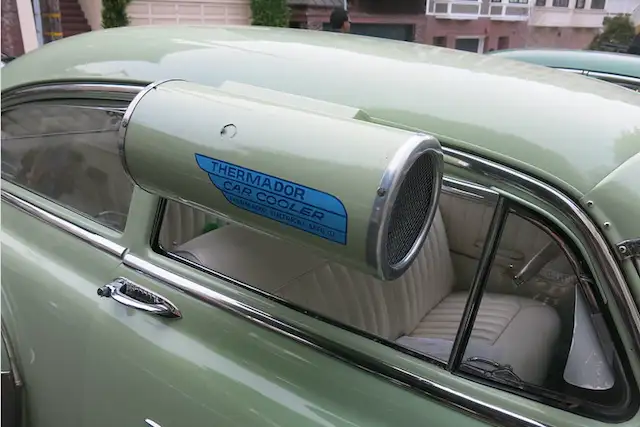
Early cooling systems relied on a simple substance: water.
Water absorbs and transfers heat extremely well, making it an ideal medium for controlling engine temperature. However, it presented two important challenges:
- It freezes at 32°F (0°C)
- It boils at 212°F (100°C)
Once either of those limits was reached, the cooling system became ineffective.
As automobiles expanded into colder regions and engines grew more powerful, water alone was no longer sufficient.
The Radiator Revolution
The next major breakthrough came with the development of the radiator.
By the early 1900s, radiators had become a common sight on automobiles. These devices allowed coolant to circulate through a network of tubes and fins, where passing air removed heat before the coolant returned to the engine.
Radiators transformed vehicle design and function by:
- improving reliability
- increasing engine power potential
- extending operating range
- reducing overheating
The familiar front-mounted radiator soon became a standard design feature across the industry.
The Birth of Antifreeze
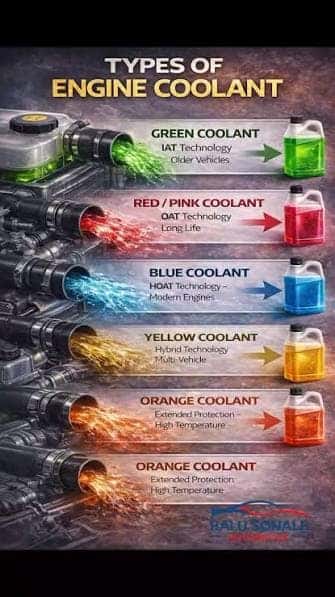
Engineers eventually discovered that mixing water with chemicals could dramatically improve cooling performance.
One of the earliest and most successful solutions was ethylene glycol, first synthesized in the mid-1800s.
When mixed with water, ethylene glycol:
- lowered the freezing point
- raised the boiling point
- expanded the functional operating range
A typical 50/50 coolant mixture could perform in temperatures from approximately -34°F to 265°F, making year-round driving practical in a way that pure water never could.
Protecting More Than Temperature
As cooling systems matured, engineers discovered another problem: corrosion.
Coolant constantly circulates through:
- cast iron
- steel
- aluminum
- copper
- brass
Without protection, these metals slowly deteriorate.
To combat this, manufacturers introduced corrosion inhibitors that protected internal engine components and extended cooling system life. Over time, coolant evolved from simply carrying heat to becoming a critical maintenance fluid that helped preserve an entire engine.
Air-Cooled vs. Water-Cooled Engines
For much of the twentieth century, two cooling philosophies competed.
Water-Cooled Engines
These systems used coolant, pumps, hoses, and radiators to transfer heat away from the engine.
Advantages included:
- better temperature control
- greater power potential
- improved durability
Air-Cooled Engines
These engines relied on cooling fins and airflow rather than liquid coolant.
Advantages included:
- fewer parts
- lower weight
- simplified maintenance
Famous air-cooled vehicles included:
- Volkswagen Beetles
- Porsche 356 models
- Early Porsche 911s
The final mainstream production air-cooled automobile was the 1998 Porsche 911 (993), marking the end of an era as manufacturers increasingly adopted more efficient water-cooled systems.
Keeping Drivers Cool
While engineers were learning how to cool engines, another challenge remained: cooling passengers.
Early automobiles were effectively open-air machines. The first Model Ts offered natural ventilation because they lacked enclosed cabins.
As automobiles became enclosed and more comfortable, heat inside the cabin became an issue.
Drivers initially relied on:
- open windows
- dashboard vents
- electric fans
- evaporative “car coolers”
These devices offered limited relief but could not truly control interior temperatures.
The Arrival of Air Conditioning
A major milestone arrived in 1939, when Packard became the first manufacturer to offer factory-installed automotive air conditioning.
The system was revolutionary but far from convenient:
- equipment was mounted in the trunk
- drivers manually engaged the compressor
- temperatures could not be adjusted
- outside air was not circulated
Nevertheless, the concept worked.
For the first time, drivers could cool an automobile cabin mechanically.
Post-War Comfort Arrives
After World War II, air conditioning rapidly gained popularity.
By the 1950s:
- General Motors
- Chrysler
- Packard
all offered improved systems.
A major breakthrough came in 1953, when General Motors developed a compact system that fit under the hood rather than consuming trunk space.
Further improvements followed:
- temperature controls
- improved airflow
- automatic climate regulation
By the late 1960s, more than half of all new American cars were equipped with air conditioning.
Environmental Challenges
The popularity of air conditioning introduced new concerns.
For decades, automotive systems relied on R-12 (Freon) refrigerant. Scientists later linked chlorofluorocarbons (CFCs) to ozone depletion.
As a result, manufacturers transitioned to the more environmentally friendly R-134a refrigerant during the 1990s.
The cooling systems inside modern vehicles continue evolving today, with refrigerants designed to minimize environmental impact while maximizing efficiency.
Modern Cooling Systems
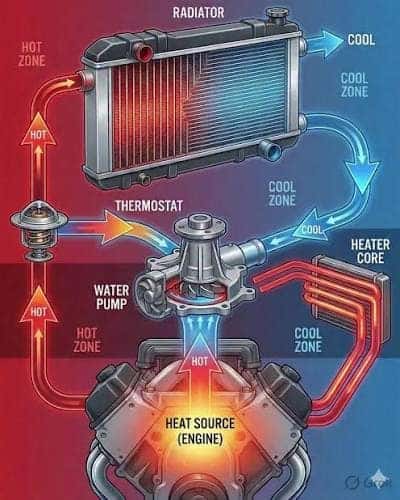
Today’s cooling systems do far more than prevent overheating.
Modern coolant:
- regulates engine temperature
- protects against freezing
- prevents corrosion
- lubricates water pumps
- supports emissions control systems
Meanwhile, climate control systems can:
- automatically maintain cabin temperatures
- provide multi-zone comfort
- cool or heat seats
- improve defrosting and visibility
Both systems work together to improve reliability, performance, efficiency, and comfort.
The Future of Cooling
As vehicles become increasingly electrified, cooling continues to evolve.
Electric vehicles require carefully managed temperatures for:
- battery packs
- electric motors
- inverters
- power electronics
Advanced cooling technologies are becoming essential to maximize battery life, charging speed, and performance.
Future developments may include:
- specialized EV coolants
- integrated thermal management systems
- climate systems that improve vehicle range and efficiency
Why It Still Matters at Mills Auto Group
Cooling technology has always been about reliability, comfort, and confidence. From the first water jackets of the 1880s to today’s sophisticated climate-control and thermal-management systems, cooling innovations have made vehicles safer, more durable, and more enjoyable to drive.
At Mills Auto Group, being Trusted for Generations means understanding the technologies that work behind the scenes every day. Whether it’s protecting an engine on a summer road trip, keeping passengers comfortable in winter, or managing the batteries of tomorrow’s electric vehicles, cooling systems remain one of the most important—and often overlooked—parts of the automotive story.
The automobile may run on power, but it depends on staying cool.
Closing Scene…
…Bentley watches the coolant flow into place, bright and clean.
“So it’s like water breaks?” she asks suddenly.
He blinks, then laughs. “That might be the best explanation I’ve ever heard.”
To Be Continued…
Dober. “A History of Coolants.” Www.Dober.Com, https://www.dober.com/history-of-coolants. Accessed 17 July 2026.
Lozano, Robert. “How Does Coolant Work in a Car – Your Engine’S Lifeline Explained.” My Blog, 18 Feb. 2026, https://engineneeds.com/how-does-coolant-work-in-a-car/. Accessed 17 July 2026.
Repairs, Kevin’s Auto. “Kevin’S Auto Repairs.” Kevinsautos.Com, 2021, https://kevinsautos.com/faq/what-was-the-first-car-with-a-cooling-system.html#google_vignette. Accessed 17 July 2026.
Sheldon, Andrew. “The History of Air Conditioning in Cars.” Your AAA Network, 2 June 2022, https://magazine.northeast.aaa.com/daily/life/cars-trucks/auto-history/the-history-of-air-conditioning-in-cars/. Accessed 17 July 2026.









0 comment(s) so far on It’s Worth the Drive – S3E5: Be Cool!!