


It’s Worth the Drive – S3E4: Driven by Data
Episode 4 – Driven by Data
The Story Continues…
A dashboard light glows faintly before shutting off.
Bentley points. “What was that?”
Her grandpa smiles. “That’s the car checking itself.”…
The Vehicle’s Digital Nervous System
Today’s vehicles are packed with technology that drivers rarely see. Hidden behind bumpers, windshields, mirrors, and body panels are dozens—sometimes more than one hundred—sensors constantly monitoring the vehicle, its occupants, and the world around it.
Much like the human nervous system, sensors collect information and send it to a vehicle’s Electronic Control Units (ECUs), which process that information and respond in milliseconds. Whether adjusting fuel delivery, deploying an airbag, measuring tire pressure, or helping prevent a collision, sensors have become essential to modern driving.
Yet automotive sensors are a relatively recent development. Their evolution mirrors the automobile’s transformation from a largely mechanical machine into a sophisticated computer on wheels.
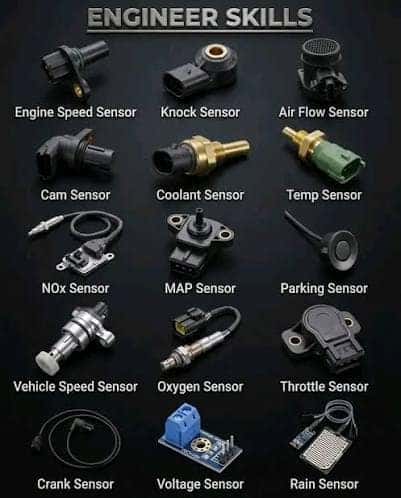
Before Sensors Took Over
In the early decades of motoring, automobiles relied almost entirely on mechanical systems. Drivers monitored vehicle health through gauges, sounds, smells, and experience rather than electronic feedback.
Most vehicle functions were controlled mechanically:
- Carburetors mixed fuel and air.
- Mechanical distributors handled ignition timing.
- Drivers manually monitored temperatures, pressures, and operating conditions.
There was no central computer coordinating vehicle systems. As cars became more powerful and regulations more demanding, however, the limitations of purely mechanical control became increasingly apparent.
The First Automotive Sensors
The first widely adopted automotive sensors appeared during the 1970s, driven largely by fuel economy and emissions requirements.
One of the most important early developments was the oxygen (O₂) sensor, which measured oxygen content in exhaust gases and helped engines maintain a more efficient air-fuel mixture.
By feeding information back to a growing number of electronic control systems, sensors allowed vehicles to:
- improve fuel economy
- reduce emissions
- increase reliability
- simplify diagnostics
These early systems laid the groundwork for modern engine management.
The Computer Age Arrives
During the 1980s and 1990s, automakers increasingly integrated onboard computers into their vehicles.
As Electronic Control Units (ECUs) became more capable, the number of sensors expanded rapidly. Instead of simply monitoring vehicle conditions, sensors began actively managing them.
Important sensors introduced during this period included:
Mass Airflow (MAF) Sensors
These sensors measure the amount of air entering the engine, allowing the ECU to determine the correct amount of fuel for efficient combustion.
Manifold Absolute Pressure (MAP) Sensors
MAP sensors calculate air pressure within the intake manifold, helping determine engine load and fuel requirements.
Crankshaft and Camshaft Position Sensors
These sensors monitor engine rotation and valve timing, ensuring fuel injection and ignition occur at precisely the right moment.
Coolant and Oil Sensors
Temperature and pressure sensors help prevent overheating while improving engine longevity.
By the turn of the millennium, sensors had become standard equipment in virtually every vehicle.
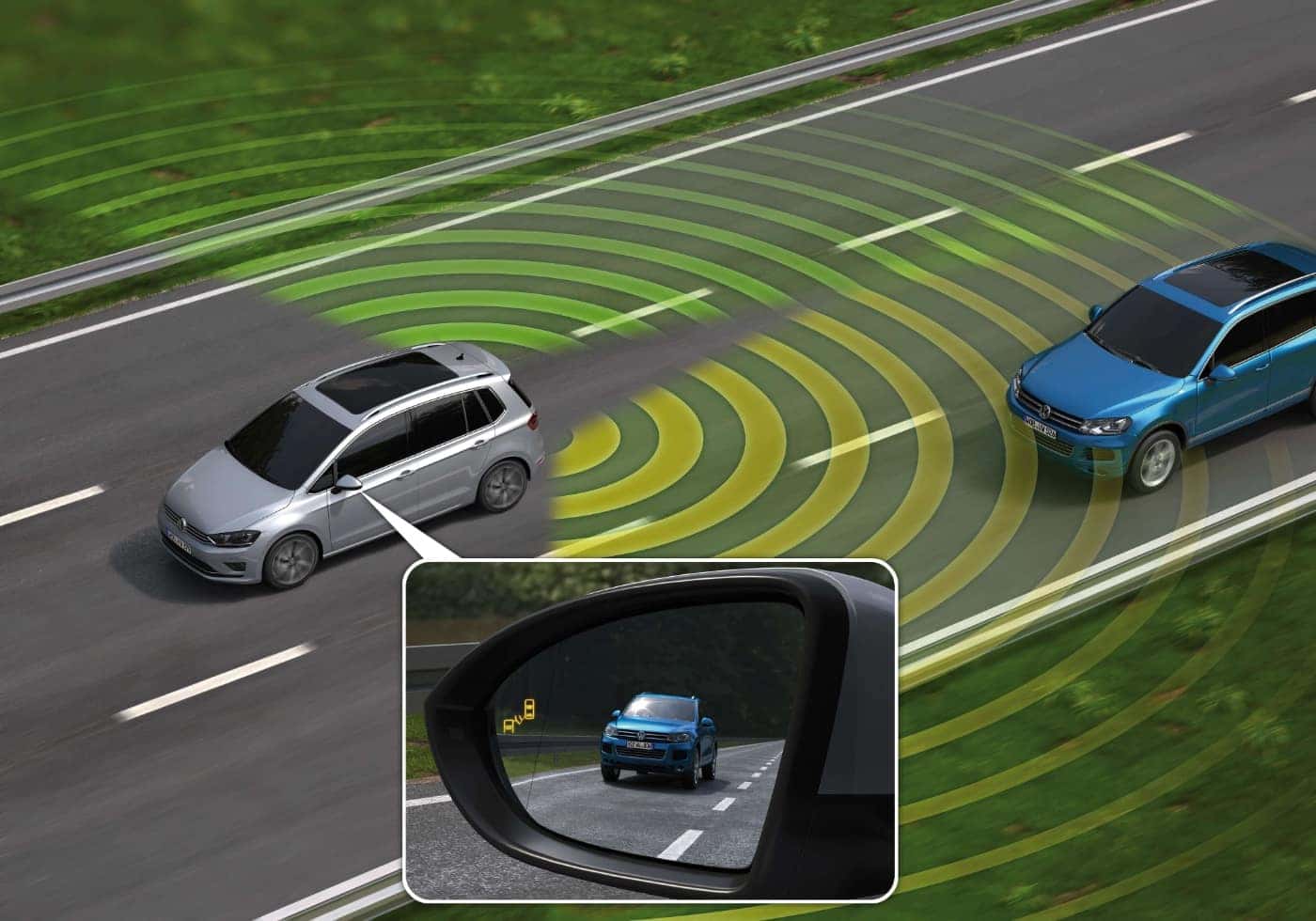
Sensors Improve Safety
As sensor technology matured, its role expanded beyond engine management and into safety systems.
ABS Wheel Speed Sensors
Anti-lock braking systems rely on sensors mounted at each wheel to detect wheel rotation. If a wheel begins to lock during braking, the system automatically adjusts brake pressure to maintain control.
Airbag Sensors
Accelerometers and impact sensors detect collisions and trigger airbag deployment within milliseconds.
Tire Pressure Monitoring Systems (TPMS)
These sensors continuously monitor tire pressure and alert drivers when levels fall below safe limits.
These technologies helped reduce accidents while improving driver awareness and vehicle stability.
Seeing Beyond the Driver
The next leap came when sensors began monitoring not only the vehicle itself but also the surrounding environment.
Ultrasonic Sensors
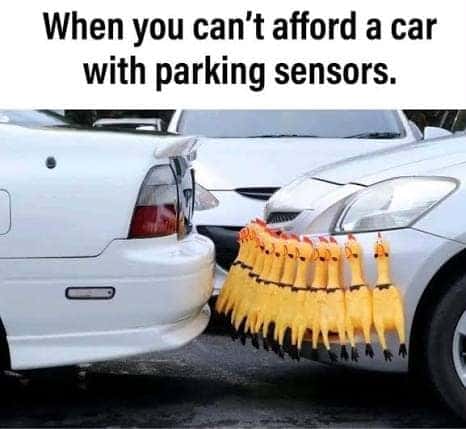
Introduced primarily for parking assistance, ultrasonic sensors use sound waves to detect nearby obstacles. They remain popular because they are:
- inexpensive
- durable
- highly accurate at short range
Today they support:
- parking assist
- automatic parking systems
- blind-spot monitoring
Cameras
Automotive cameras provide visual awareness of the vehicle’s surroundings.
Modern camera systems can:
- recognize lane markings
- detect pedestrians
- identify traffic signs
- monitor traffic lights
- provide 360-degree vehicle views
Infrared technology even allows some camera systems to detect people and animals at night.
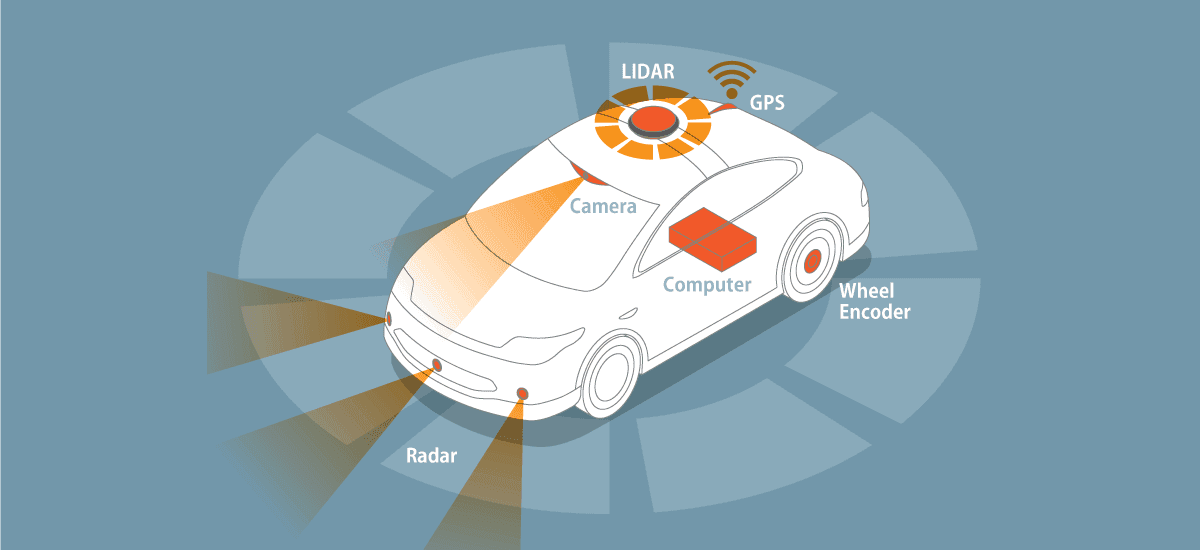
Radar
Radar uses electromagnetic waves to determine the location, speed, and direction of surrounding objects.
Radar is particularly useful for:
- adaptive cruise control
- blind spot detection
- forward collision warning
- automatic emergency braking
Unlike cameras, radar performs well in darkness, rain, fog, and snow.
Sensor Fusion: When Sensors Work Together
A major breakthrough in automotive technology came with sensor fusion.
Instead of operating independently, multiple sensor types now work together to create a complete understanding of the vehicle’s surroundings.
For example:
- Cameras identify lane markings.
- Radar measures vehicle distance and speed.
- Ultrasonic sensors detect nearby obstacles.
- GPS provides positioning data.
The vehicle compares all available information to verify accuracy before making decisions.
This redundancy dramatically improves reliability and helps prevent false readings.
Sensor fusion forms the foundation of modern:
- adaptive cruise control
- lane-centering systems
- traffic jam assist
- highway driving assist
- automatic emergency braking
LiDAR and the Road to Autonomy
One of the most advanced sensing technologies is LiDAR (Light Detection and Ranging).
LiDAR uses laser pulses to create detailed three-dimensional maps of the environment. Unlike radar, which excels at measuring movement and distance, LiDAR can build highly accurate representations of:
- vehicles
- pedestrians
- road edges
- obstacles
- infrastructure
Advanced LiDAR systems promise:
- real-time 3D environmental mapping
- faster object recognition
- improved autonomous decision-making
Many manufacturers view LiDAR as a key technology on the path toward fully autonomous vehicles.
How Many Sensors Are in Modern Vehicles?
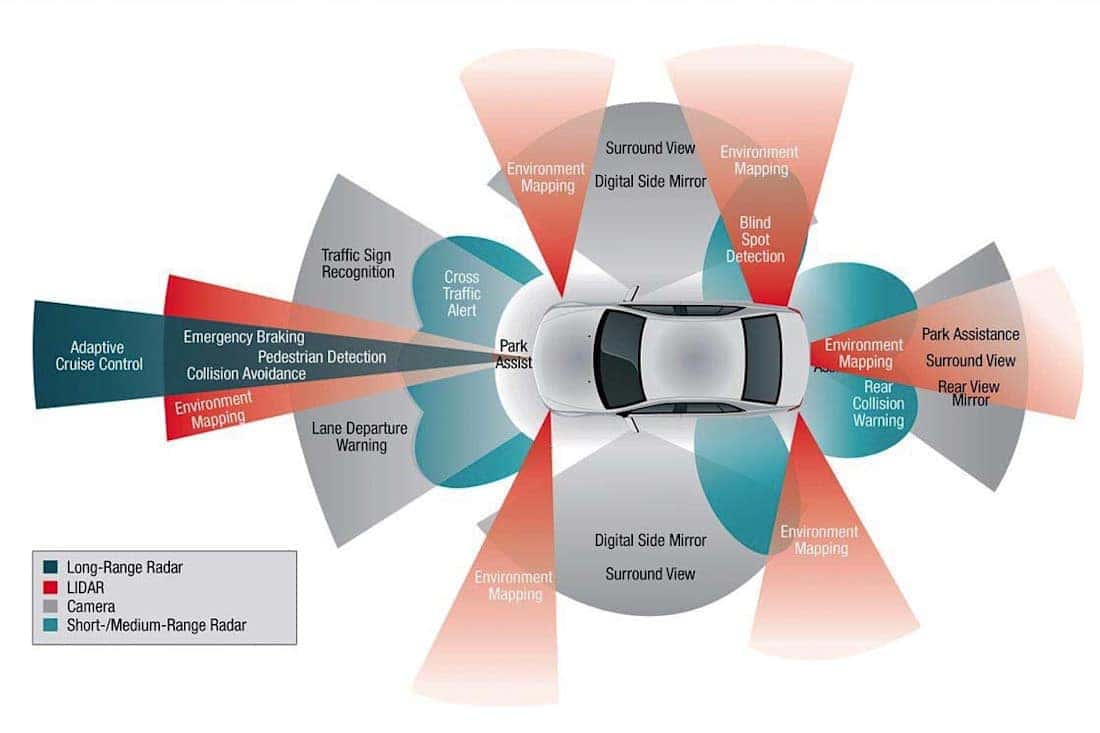
A typical vehicle from the 1980s may have contained only a handful of sensors.
Today, modern vehicles routinely contain:
- 70–100+ sensors in conventional vehicles
- 200+ sensors in advanced luxury and electric vehicles
These monitor nearly every aspect of operation, including:
- engine performance
- emissions
- braking
- steering
- suspension
- climate control
- tire pressure
- driver behavior
- vehicle surroundings
The Next Step: Connected Vehicles
The future extends beyond sensors mounted on the vehicle.
Engineers are developing:
- Vehicle-to-Vehicle (V2V) communication
- Vehicle-to-Infrastructure (V2I) communication
- Vehicle-to-Everything (V2X) communication
These systems would allow vehicles to exchange information with:
- other vehicles
- traffic signals
- road infrastructure
- pedestrians
Combined with advanced sensors, this connectivity may eventually enable safer and more efficient autonomous transportation.
Why It Still Matters at Mills Auto Group
Modern vehicles are safer, more efficient, and more capable than ever, largely because of sensors. These small devices quietly monitor hundreds of conditions every second, helping drivers avoid accidents, improve fuel economy, maintain vehicle health, and navigate the road with greater confidence.
At Mills Auto Group, being Trusted for Generations means helping customers understand the technology that powers today’s vehicles. Whether it’s a tire-pressure sensor warning of low air, a camera helping maintain lane position, or a radar system preventing a collision, sensors have become an essential part of the ownership experience.
From a single oxygen sensor in the 1970s to the sophisticated sensor networks guiding tomorrow’s autonomous vehicles, their evolution reflects one of the most important technological transformations in automotive history—and one that continues to shape every mile ahead.
Closing Scene…
…“You mean the car tells you when it’s confused?” Bentley asks.
“Not confused,” he says. “Just paying attention.”
She nods thoughtfully. “I should try that more.”
To Be Continued…
Cope, Liam. “What Are Sensors in a Car and How Do They Work? – Engineer Fix.” Engineer Fix, 4 Dec. 2025, https://engineerfix.com/what-are-sensors-in-a-car-and-how-do-they-work/#google_vignette. Accessed 16 July 2026.
Croft, Tom. “The Evolution of Car Sensors: Enhancing Safety and Performance – VehicleReport.” Vehiclereport.Com, 2024, https://vehiclereport.com/blog/the-evolution-of-car-sensors-enhancing-safety-and-performance. Accessed 16 July 2026.
IAA Mobility. “IAA MOBILITY: The Evolution of Vehicle Sensor Systems.” Www.Iaa-Mobility.Com, https://www.iaa-mobility.com/en/newsroom/news/future-technology/the-evolution-of-vehicle-sensor-systems. Accessed 16 July 2026.
Team Ackodrive. “Different Types of Sensors in a Car and Its Functions.” AckoDrive, 30 Nov. 2021, https://ackodrive.com/car-guide/different-types-of-car-sensors/. Accessed 16 July 2026.
Tito. “Car Sensors and Their Functions [26 Most Common Sensors].” Rx Mechanic, 2026, https://rxmechanic.com/car-sensors-and-their-functions/. Accessed 16 July 2026.









0 comment(s) so far on It’s Worth the Drive – S3E4: Driven by Data