


It’s Worth the Drive – S3E2: The Brains of the Operation
 Episode 2 – The Brains of the Operation
Opening
The engine doesn’t turn over at first.
Bentley looks up, startled. “Did we break it?”
Her grandpa shakes his head. “Nope. Just means it’s trying to tell us something.”
He points to the battery. Black casing. Red and black cables. Quiet, unassuming.
“This is where everything wakes up.”
The Quiet Component That Makes Cars Possible
The car battery rarely gets attention equal to engines, transmissions, or styling, yet no automobile—past or present—can function without one. Long before electric vehicles entered the mainstream, batteries were already central to automotive reliability, safety, and convenience.
At its most basic level, the battery stores energy so it can be released precisely when needed. Over time, advances in chemistry, materials, and electrical management transformed the battery from a simple engine-starting aid into the foundation of an entirely new kind of automobile.
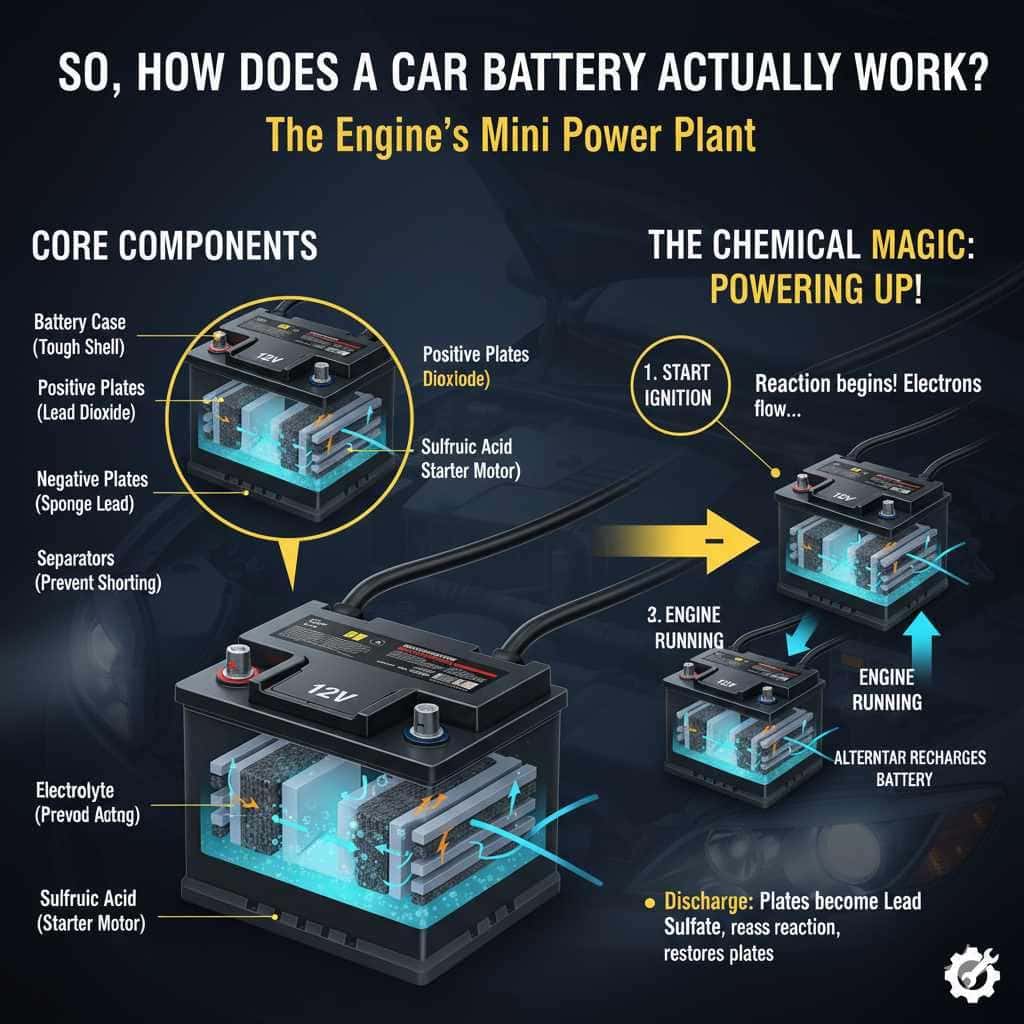
How a Car Battery Works
All batteries operate on the same fundamental principle: stored chemical energy is converted into electrical energy through a controlled reaction.
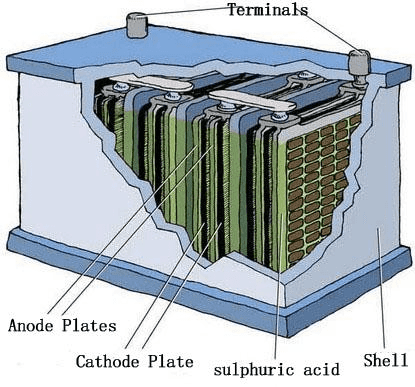
Every battery contains three essential components:
- Anode (negative terminal)
- Cathode (positive terminal)
- Electrolyte, which allows ions to move between them
When a battery discharges, a chemical reaction at the anode releases electrons. Those electrons travel through the vehicle’s electrical system—powering starters, lights, computers, and accessories—before returning to the cathode. Charging reverses that process, restoring the battery’s stored energy.
This reversible reaction is what makes automotive batteries rechargeable—and indispensable.
Early Electrical Foundations
The concept of electrical storage predates the automobile itself. In 1800, Alessandro Volta demonstrated a continuous electric current with his voltaic pile. While not rechargeable, it proved that electricity could be stored and delivered on demand.
The major breakthrough came in 1859, when Gaston Planté invented the lead‑acid battery, the first practical rechargeable battery. This chemistry—based on lead plates submerged in sulfuric acid—remains in use today.
Lead‑Acid Batteries and the Early Automobile
As cars emerged in the late 19th and early 20th centuries, lead‑acid batteries quickly proved practical. Their advantages included:
- durability
- low cost
- reliable power delivery
- easy recharging
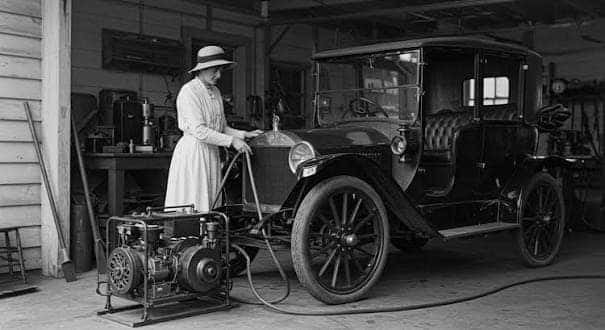
Initially, batteries powered only lights and accessories. Engines were hand‑cranked—a difficult and sometimes dangerous task.
That changed in 1911, when Charles Kettering’s electric starter debuted on Cadillac vehicles. The battery suddenly became central to vehicle operation, not just convenience.
Modern gasoline vehicles still rely on 12‑volt lead‑acid batteries to power:
- starting
- lighting
- ignition (SLI systems)
- computers and electronics
Despite their age, lead‑acid batteries remain one of the most recycled products in the world, with nearly 100% material recovery.
Understanding the Limits of Lead‑Acid
While reliable, lead‑acid batteries have major limitations:
- low energy density (~35 Wh/kg)
- heavy weight
- poor performance when deeply discharged
These constraints make them unsuitable as primary propulsion sources. Early electric vehicles powered by lead‑acid batteries were heavy, had short range, and required frequent maintenance.
This limitation would shape battery development for decades.
Nickel‑Metal Hydride: A Step Toward Mobility
A major improvement arrived with nickel‑metal hydride (NiMH) batteries, developed in the late 20th century. NiMH batteries roughly doubled energy density over lead‑acid and provided:
- longer life cycles
- stable voltage output
- safer electrolytes
NiMH batteries found success in early electric vehicles and, more enduringly, in hybrid vehicles. Toyota, in particular, proved their durability with long‑lasting hybrid battery packs.
Still, NiMH batteries were bulky and not energy‑dense enough to make long‑range electric cars practical.
Battery Management Changes Everything
Equally important as chemistry was the introduction of battery management systems (BMS).
A BMS continuously monitors:
- voltage
- temperature
- state of charge
- cell balance
These systems prevent over‑charging, deep discharge, and overheating—dramatically extending battery life and improving safety. Modern batteries are no longer passive components; they are actively managed energy systems.
This advancement set the stage for the next leap.
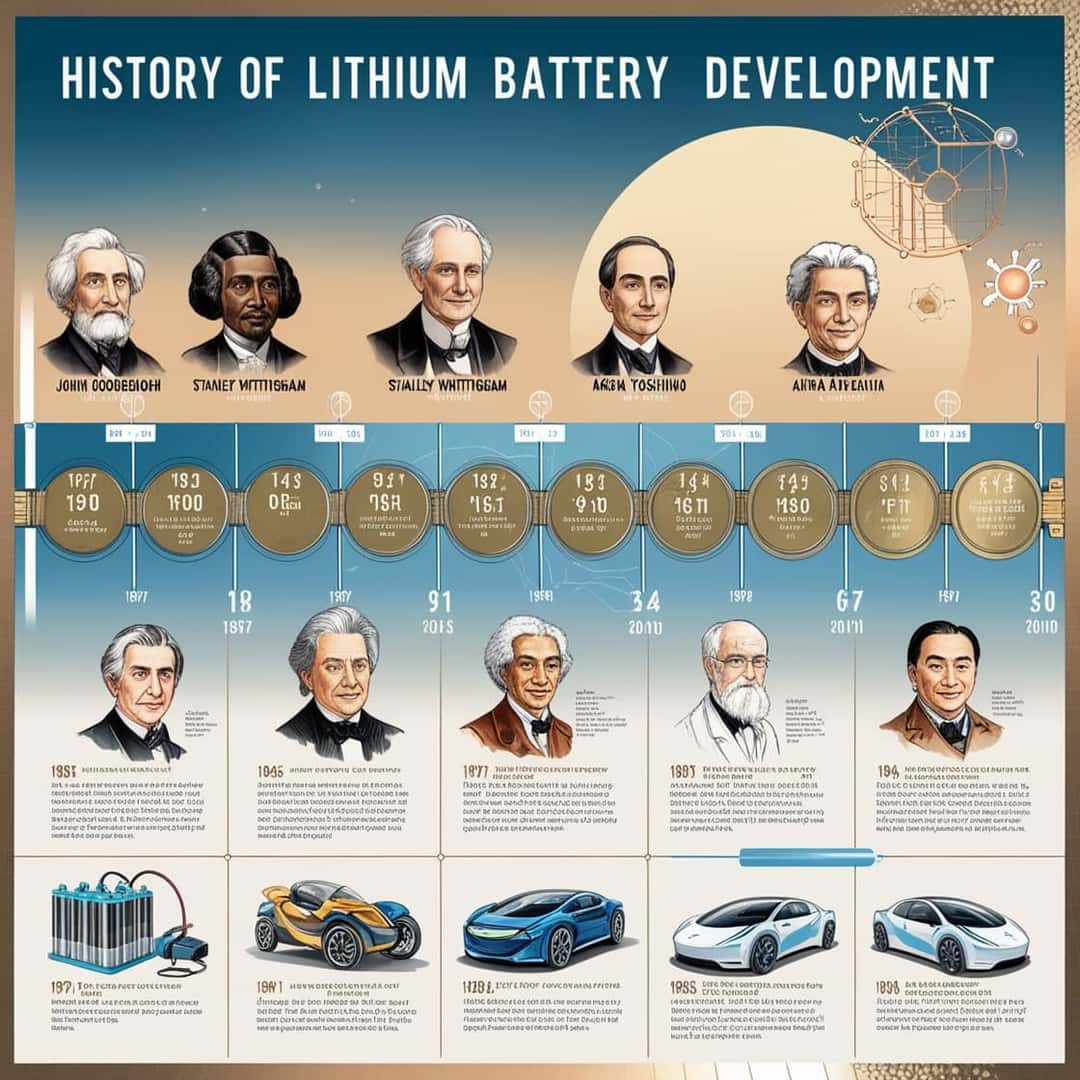
Lithium‑Ion: When Batteries Became the Powertrain
Lithium‑ion batteries—commercialized in the 1990s—offered a revolutionary leap in capability:
- energy density 4–8× higher than lead‑acid
- far lighter weight
- low self‑discharge
- scalable modular design
Initially used in electronics, lithium‑ion batteries required extensive refinement to meet automotive safety and durability standards. Thermal management, software control, and pack architecture became as important as chemistry.
Once solved, lithium‑ion batteries did what generations of earlier batteries could not:
they made electric vehicles viable for everyday drivers.
From Battery to Vehicle: The Rise of the EV
As lithium‑ion batteries improved, electric vehicles evolved rapidly.
Range climbed from under 100 miles in early mainstream EVs to nearly 300 miles on average today, driven by:
- higher energy‑density cells
- better BMS software
- more efficient vehicle design
The same battery that once only started engines now stores enough energy to replace them entirely.
Hybrid vehicles bridged the transition, combining internal combustion with electric propulsion. Fully electric vehicles followed—not as curiosities, but as practical transportation.
What Comes Next
Battery development continues along several paths:
- solid‑state batteries with higher energy density and improved safety
- improved lithium‑iron‑phosphate (LFP) chemistries
- smarter charging and energy recovery
- more sustainable materials and manufacturing
Each advance traces directly back to the original challenge: how to store energy safely, efficiently, and reliably inside a vehicle.
Why It Still Matters at Mills Auto Group
The car battery has evolved from a supporting component into the foundation of modern mobility. Whether starting a gasoline engine, supporting a hybrid system, or powering a fully electric vehicle, every driver depends on stored electrical energy—often without realizing it.
At Mills Auto Group, being Trusted for Generations means helping customers understand what powers their vehicles today and tomorrow. From traditional lead‑acid batteries to advanced lithium‑based systems, knowing how these technologies evolved builds confidence in ownership, maintenance, and long‑term value.
Electric vehicles did not appear overnight. They are the result of over a century of battery development, and that story continues—one charge at a time.
Closing
The car starts on the first try after reconnecting the cables.
Bentley jumps a little at the sound, then laughs.
“So it’s like the spark?” she asks.
“Exactly,” he says. “Power doesn’t mean much if it can’t start something.”

AutoZone. “How Does a Car Battery Work?” AutoZone.com, AutoZone, 2019, www.autozone.com/diy/battery/how-car-batteries-work?msockid=165c70215f2e6bdf032167075e376a1b. Accessed 23 Apr. 2026.
Meraj, Md. “How a Car Battery Works: Essential Guide.” Thedailyautomotive.com, 27 May 2024, thedailyautomotive.com/how-a-car-battery-works/. Accessed 23 Apr. 2026.
Scott, Victoria. “From Lead-Acid to Lithium: A History of the Automotive Battery.” Road & Track, 20 Oct. 2023, www.roadandtrack.com/car-culture/a45597186/history-of-automotive-batteries/.
Toolrage. “The Complete History of the Car Battery.” Toolrage, 30 Oct. 2023, www.toolrage.com/the-complete-history-of-the-car-battery/.









0 comment(s) so far on It’s Worth the Drive – S3E2: The Brains of the Operation