


It’s Worth the Drive – S3E10: Traction Matters
Episode 10 – Traction Matters
The Story Continues…
They step back and look at the whole car now.
“All that power,” Bentley says, “has to go somewhere.”
Her grandpa explains slowly, using chalk on the concrete floor — lines, arrows, paths…
Getting Power to the Ground
Creating horsepower is only half the battle.
From the earliest automobiles to today’s electric vehicles, engineers have faced the same challenge: how do you efficiently transfer power from the engine to the road?
That challenge gave birth to the drivetrain.
While engines produce power and transmissions control it, the drivetrain ultimately determines which wheels receive that power. Over more than a century, drivetrain technology has evolved from simple rear-wheel-drive systems to sophisticated all-wheel-drive systems capable of automatically controlling traction hundreds of times per second.
The history of the automobile is, in many ways, the history of learning how to put power to the pavement.
Rear-Wheel Drive: The Original Automobile Layout
The earliest automobiles were almost universally rear-wheel drive.
By the 1890s, French manufacturer Panhard et Levassor developed a layout that placed:
- the engine in front
- the transmission behind it
- a driveshaft running to the rear axle
This design became known as the Panhard System and established the blueprint that would dominate automotive design for decades.
The arrangement was simple, durable, and easy to manufacture. Most importantly, it worked.
By the early twentieth century, rear-wheel drive had become the standard configuration for nearly every major automobile manufacturer.
Why Rear-Wheel Drive Dominated
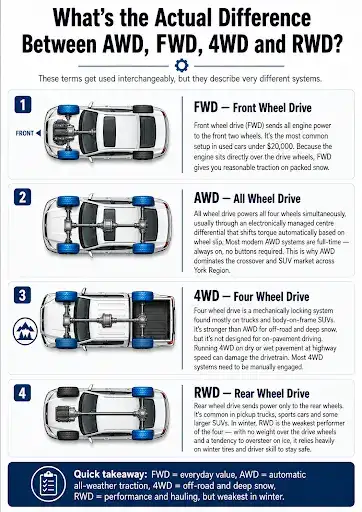 Rear-wheel drive allowed the front and rear wheels to perform separate jobs.
The front wheels:
- steered the vehicle
The rear wheels:
- delivered power to the road
This created several advantages:
- predictable handling
- strong acceleration
- robust towing capability
- excellent durability
As automobiles became larger and more powerful, rear-wheel drive remained the preferred configuration for luxury vehicles, trucks, and performance cars.
For much of automotive history, this was simply how automobiles were built.
The First Attempts at Front-Wheel Drive
Even while rear-wheel drive dominated the industry, some engineers explored a very different idea.
What if the front wheels could both steer and drive the vehicle?
The concept appeared surprisingly early.
French inventor Léon Bollée experimented with front-wheel-drive ideas during the late nineteenth century. American engineer J. Walter Christie built front-wheel-drive racing cars during the early 1900s.
The problem wasn’t the idea—it was the engineering.
Driving and steering the same wheels required complex joints and components that early manufacturers struggled to produce reliably.
Citroën Changes the Industry
A major breakthrough arrived in 1934 with the introduction of the Citroën Traction Avant.
Widely regarded as the first successful mass-produced front-wheel-drive automobile, the Traction Avant introduced a layout that would eventually transform the industry.
The advantages were significant:
- improved packaging
- lower weight
- more passenger space
- reduced manufacturing costs
- improved traction in poor weather
Although adoption was initially slow, the foundations had been laid.
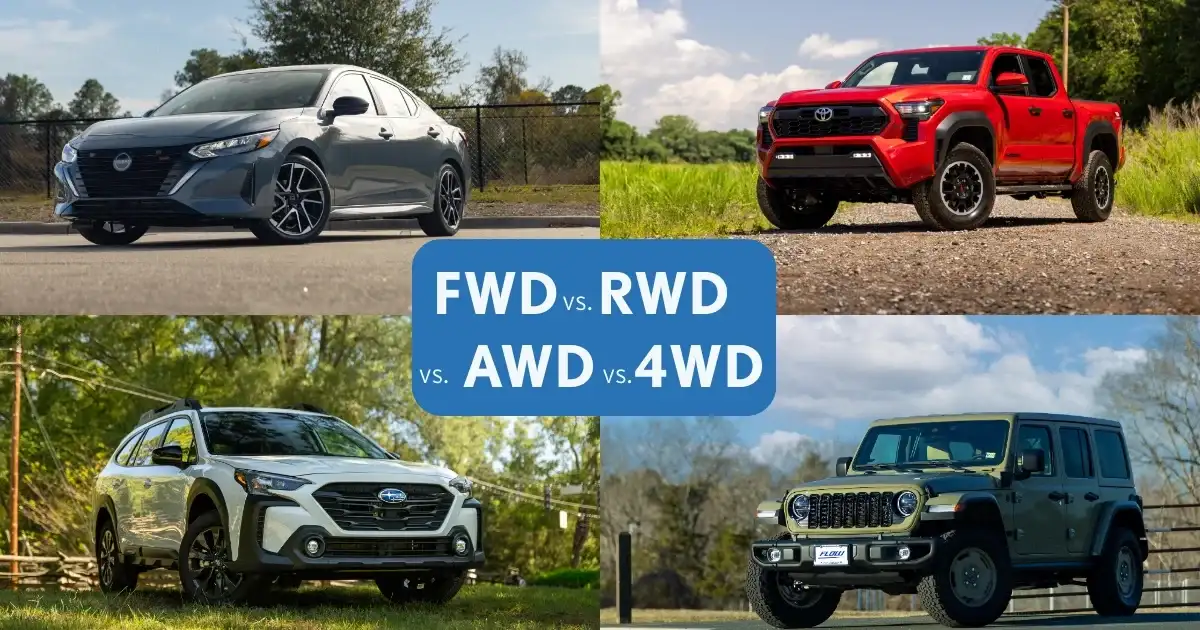
The Fuel Crises of the 1970s
For decades, front-wheel drive remained relatively uncommon outside Europe.
Then came the energy crises of the 1970s.
Rising fuel prices forced manufacturers to focus on efficiency and weight reduction. Front-wheel drive offered several advantages that became increasingly attractive:
- lighter vehicles
- lower production costs
- improved fuel economy
- greater interior room
Throughout the 1980s and 1990s, automakers rapidly shifted toward front-wheel-drive platforms.
Today, front-wheel drive remains the most common drivetrain for:
- sedans
- compact cars
- crossover SUVs
- minivans
The Quest for More Traction
While front-wheel drive improved efficiency and rear-wheel drive excelled in performance, another challenge remained.
What happens when roads become muddy, snowy, icy, or rugged?
Engineers began searching for ways to deliver power to more than one axle.
One of the earliest known concepts came from British engineer Bramah Joseph Diplock, who patented a four-wheel-drive system in 1893.
A few years later, the Dutch-built Spyker 60 HP became one of the world’s first gasoline-powered automobiles capable of driving all four wheels.
The goal wasn’t speed.
The goal was traction.
The Military Accelerates Four-Wheel Drive Development
The real breakthrough for four-wheel drive occurred during the First and Second World Wars.
Military vehicles needed to cross:
- mud
- snow
- sand
- rough terrain
Traditional two-wheel-drive vehicles often became stuck.
Four-wheel-drive systems proved invaluable.
The most famous example was the Willys Jeep of World War II. Rugged, reliable, and capable of reaching places other vehicles could not, the Jeep demonstrated the practical value of powering all four wheels.
By war’s end, four-wheel drive had established itself as a critical technology.
The Birth of the Off-Road Vehicle
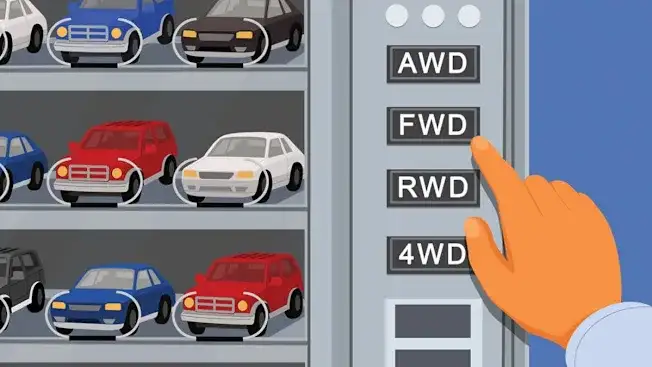
Following World War II, four-wheel drive moved into civilian use.
Farmers, ranchers, forestry workers, contractors, and outdoor enthusiasts quickly embraced the technology.
Vehicles such as:
- the Willys CJ
- the Land Rover
- the Toyota Land Cruiser
- the Ford Bronco
- the Jeep CJ series
helped create the modern off-road and SUV markets.
Four-wheel drive became synonymous with adventure and capability.
Understanding Four-Wheel Drive
Traditional 4WD systems are designed for demanding conditions.
Most feature:
- a transfer case
- high and low gear ranges
- locking differentials
- heavy-duty driveline components
These systems provide exceptional traction in:
- deep snow
- rocky terrain
- mud
- steep inclines
For serious off-road use, four-wheel drive remains the gold standard.
The Rise of All-Wheel Drive
As sport utility vehicles became more popular, many drivers wanted additional traction without the complexity of traditional four-wheel-drive systems.
Manufacturers responded with all-wheel drive (AWD).
Unlike traditional 4WD, AWD operates automatically, continuously monitoring conditions and distributing power wherever traction is needed.
Rather than focusing on extreme off-road capability, AWD was designed for:
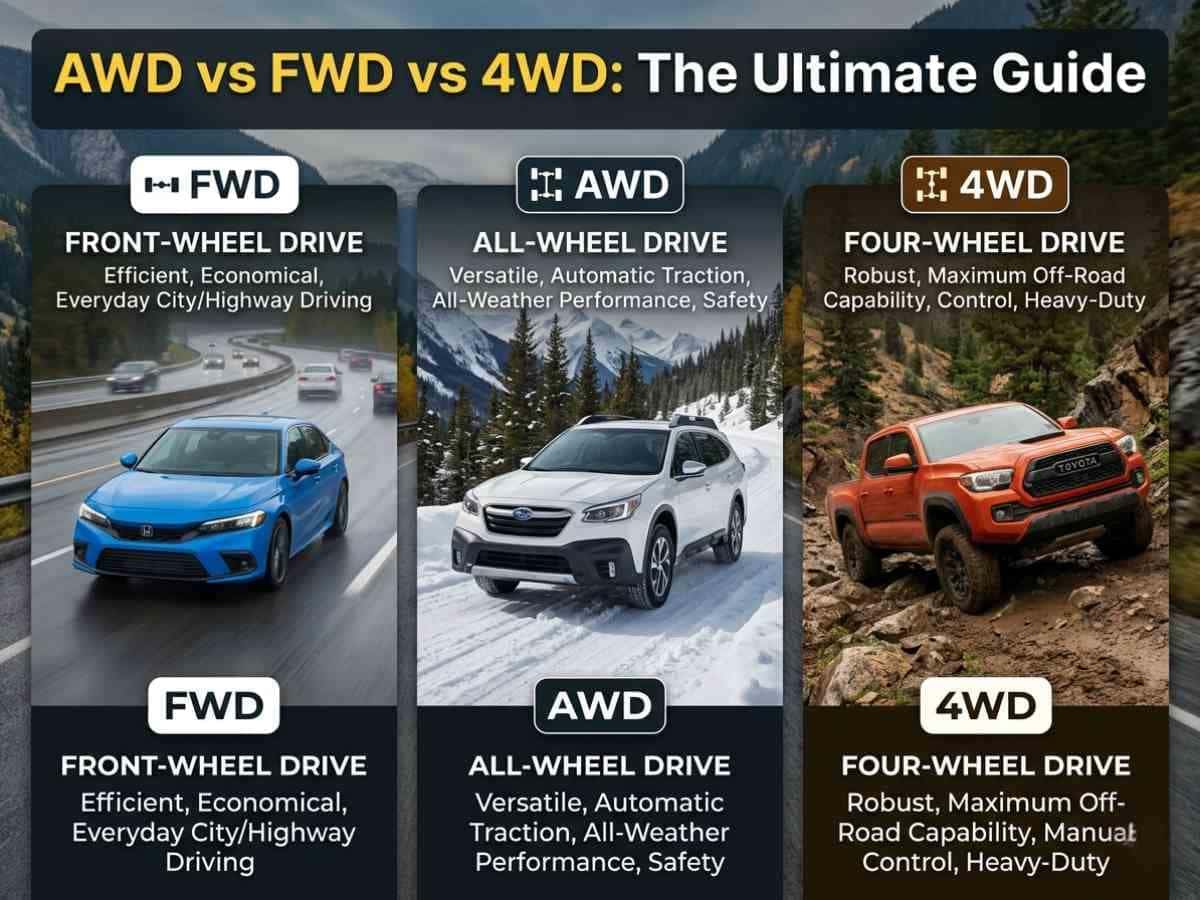
- rain
- snow
- ice
- changing road surfaces
It provided confidence and safety for everyday drivers.
Subaru and Audi Lead the AWD Revolution
Two manufacturers played particularly important roles in the development of consumer AWD.
Subaru
Beginning in the 1970s, Subaru embraced all-wheel drive as a core part of its identity. By the late twentieth century, it had become one of the brand’s defining technologies.
Audi
Audi transformed public perception of AWD with the introduction of the Quattro system in 1980.
Audi’s rally victories demonstrated that AWD could enhance performance as well as traction.
The Quattro system helped inspire a new generation of performance-oriented all-wheel-drive vehicles.
The Electronic Age
Modern drivetrains are vastly more sophisticated than their predecessors.
Computers now manage systems that can:
- monitor wheel speed
- detect wheel slip
- adjust traction
- redistribute torque
- improve vehicle stability
Some modern AWD systems can alter power delivery dozens of times per second, dramatically improving both safety and performance.
The drivetrain has become as much a software system as a mechanical one.
Electric Vehicles Rewrite the Rules
Electric vehicles are creating the next major drivetrain revolution.
Instead of using driveshafts and transfer cases, many EVs simply use separate electric motors.
Examples include:
- one motor driving the front axle
- another driving the rear axle
This arrangement provides instant all-wheel-drive capability without many of the mechanical components found in traditional vehicles.
The result is:
- improved efficiency
- reduced complexity
- remarkable traction
In some ways, drivetrain technology is returning to ideas first explored by Ferdinand Porsche’s electric all-wheel-drive concepts more than a century ago.
Why It Still Matters at Mills Auto Group
The evolution of the drivetrain reflects more than a century of engineering focused on solving one simple problem: how to get power to the road as effectively as possible. Whether through rear-wheel drive, front-wheel drive, four-wheel drive, or all-wheel drive, each innovation was developed to meet the changing needs of drivers and the environments in which they traveled.
At Mills Auto Group, being Trusted for Generations means helping customers understand the technologies that make today’s vehicles more capable, more efficient, and safer than ever before. Whether driving Minnesota highways, navigating winter weather, towing a trailer, or exploring off the beaten path, the drivetrain beneath the vehicle plays a critical role in the experience.
From the first rear-wheel-drive automobiles of the nineteenth century to the intelligent all-wheel-drive and electric systems of today, the history of the drivetrain is a story of traction, capability, and innovation—a story that continues every time a vehicle puts power to the pavement.
Bentley brushes the chalk away with her shoe.
“So it’s about balance,” she says. “About where the strength goes.”
Her grandpa nods.
They stand quietly for a moment, the car between them — not just a machine now, but a shared understanding.
SEASON 3 — CLOSING
Hands a Little Greasier, Minds a Little Fuller
The hood closes. Tools are returned to their hooks.
Bentley removes her gloves and sets them neatly on the bench — already knowing where things belong.
She looks up. “What’s next?”
Her grandpa smiles.
“There’s always something.”
The garage door lowers.
The car waits.
And the lesson doesn’t end — it just idles, ready for the next curious question.
 Consumer Reports. “How It Works: FWD Vs. RWD Vs. AWD Vs. 4WD.” Consumer Reports, 17 July 2021, https://www.consumerreports.org/cars/automotive-technology/2wd-vs-awd-vs-4wd-a5663578720/?msockid=165c70215f2e6bdf032167075e376a1b. Accessed 17 July 2026.
Cope, Liam. “When Was Four-Wheel Drive (4×4) Invented? – Engineer Fix.” Engineer Fix, 5 Dec. 2025, https://engineerfix.com/when-was-four-wheel-drive-4×4-invented/. Accessed 17 July 2026.
—. “Who Invented All-Wheel Drive? A Look at the First AWD – Engineer Fix.” Engineer Fix, 10 Jan. 2026, https://engineerfix.com/who-invented-all-wheel-drive-a-look-at-the-first-awd/. Accessed 17 July 2026.
FlowAuto. “New and Used Car Dealerships in NC and VA | Flow Automotive.” Flowauto.Com, 2026, https://www.flowauto.com/news/drivetrain-explained. Accessed 17 July 2026.
Risen, John. “The Shocking Truth About the First FWD Car and How It Changed the Automotive Industry Forever.” Temporary, 21 May 2026, https://which-kit.com/the-shocking-truth-about-the-first-fwd-car-and-how-it-changed-the-automotive-industry-forever/. Accessed 17 July 2026.
“Sign in – Wikiwand.” Wikiwand, 2026, https://www.wikiwand.com/en/rear-wheel_drive. Accessed 17 July 2026.










0 comment(s) so far on It’s Worth the Drive – S3E10: Traction Matters