


It’s Worth the Drive – S2E2: The Road Beneath the Wheels
Episode 2 — The Road Beneath the Wheel
The Story Continues…
The road bends gently ahead.
Bentley tilts her head. “Why does it curve like that?” she asks. “Why not straight?”
Grandpa explains how roads anticipate people—how slopes slow you naturally, how wide lanes forgive mistakes, how the road quietly helps without asking.
Bentley presses her hand against the door, feeling the curve carry them through…
Design Before Direction
Roads were never designed first for speed. They were designed for certainty.
The earliest constructed roads—stone‑paved streets in Ur around 4000 BC, and timber trackways laid over wetlands in Glastonbury, England—were built to solve a simple problem: how to move people and goods reliably across difficult terrain. Mud swallowed carts. Swamps trapped animals. Uneven ground slowed trade.
Early road design focused on firmness and drainage rather than direction, markings, or rules. If a surface stayed solid and passable, it succeeded. How people used it was left to negotiation.
At slow speeds, the design didn’t need instruction.
Rome Teaches Roads to Think Long‑Term
The Romans were the first to design roads with a lifespan measured in centuries.
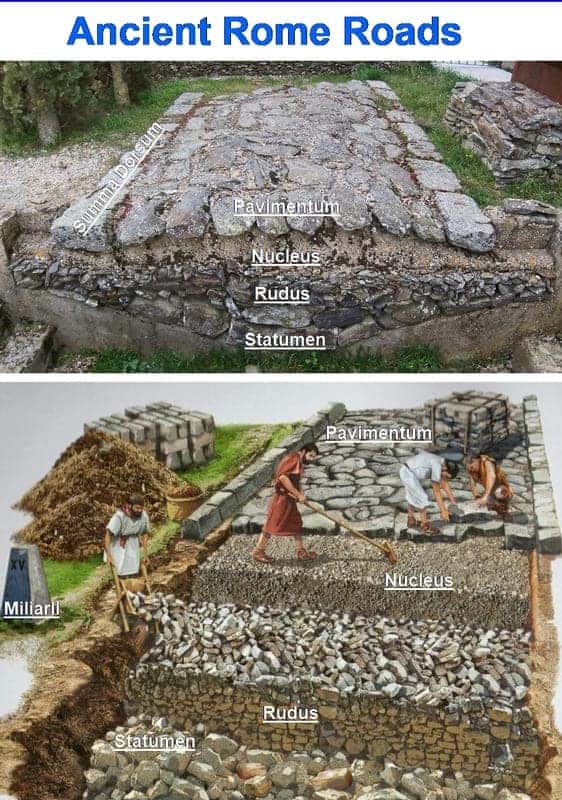
Beginning in the 4th century BC, Roman engineers layered roads with stone foundations, compacted gravel, and fitted paving stones. They crowned roads at the center, so water would run off to the sides—a feature still used today.
This design choice answered a critical question: What destroys roads first?
The answer was water, not traffic.
As roads became permanent assets, Romans introduced rules to preserve them—restrictions on heavy carts, limits on daytime use in dense cities, and minimum road widths. Road design and road regulation began evolving together.
But even now, roads were still shared spaces, not channels.
Why Roads Got a “Left” and a “Right”
Directions on roads did not start as law. It started as a habit shaped by human bodies and tools.
In medieval Europe, most travelers rode horses. Riders mounted from the left and carried weapons on the right. Passing others on the left kept the dominant hand free. Roads bent to this logic.
That is why Britain—and much of Europe—established left‑side travel long before automobiles existed.
Direction emerged because roads had to feel intuitive to users.

Wagons Rewrite the Rules
The design changed when roads began carrying freight rather than foot traffic.
In 18th‑century America, roads were dominated by large load‑bearing wagons, especially the Conestoga. Drivers controlled these from the left side of the wagon or from the left rear horse. From that position, keeping to the right side of the road allowed better judgment of clearance and passing space.
This wasn’t political or cultural—it was geometry and visibility.
As road surfaces improved and wagons grew larger, American roads naturally favored right‑hand travel. Laws followed soon after. By the mid‑1800s, the United States had standardized direction based on what its roads were being used for.
Road design dictated traffic flow, not the other way around.
Why Roads Became Straighter, Smoother, and Wider
The next major influence was engineering.
In the 18th and 19th centuries, figures like Thomas Telford and John Loudon McAdam redesigned roads to handle wheels more efficiently. Roads were elevated, drained, graded, and surfaced with broken stone to reduce resistance and increase durability.
Straight lines minimized distance. Gradual curves reduced strain on animals and vehicles. The width allowed passing without stopping.
Each design choice solved a mechanical limitation of the time.
When roads became smoother, speed increased. And once speed increased, rules became unavoidable.
Why Asphalt Changed Everything
Asphalt answered a new question: How do we design roads for comfort and consistency at higher speeds?
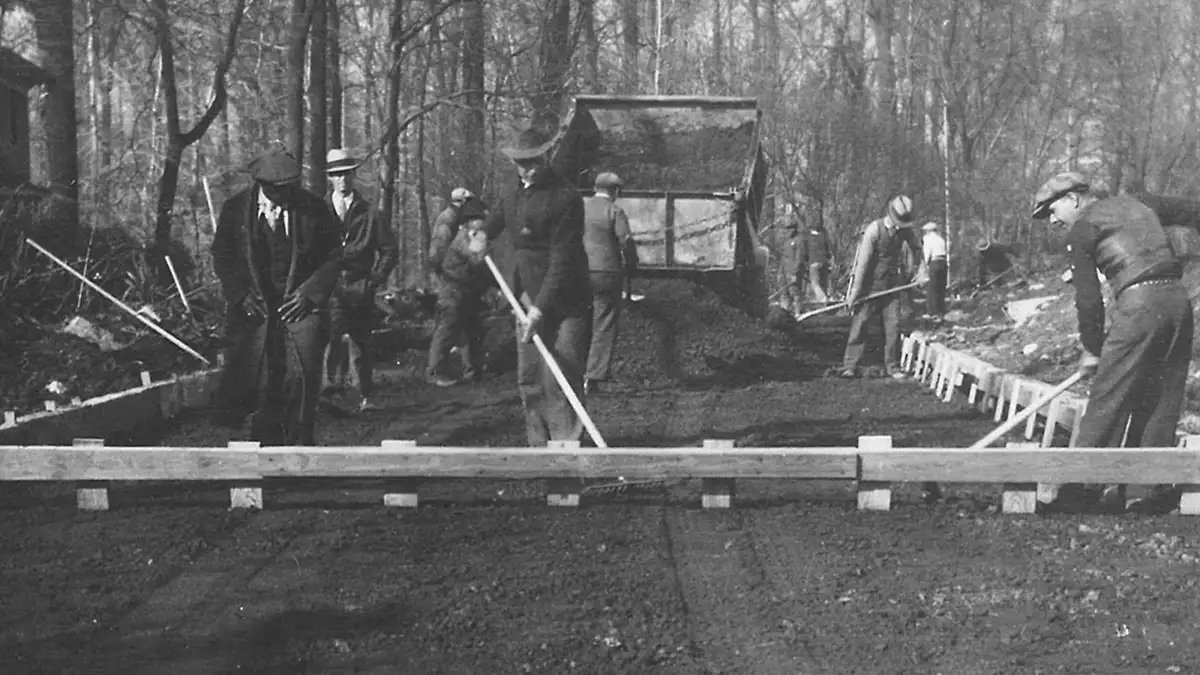
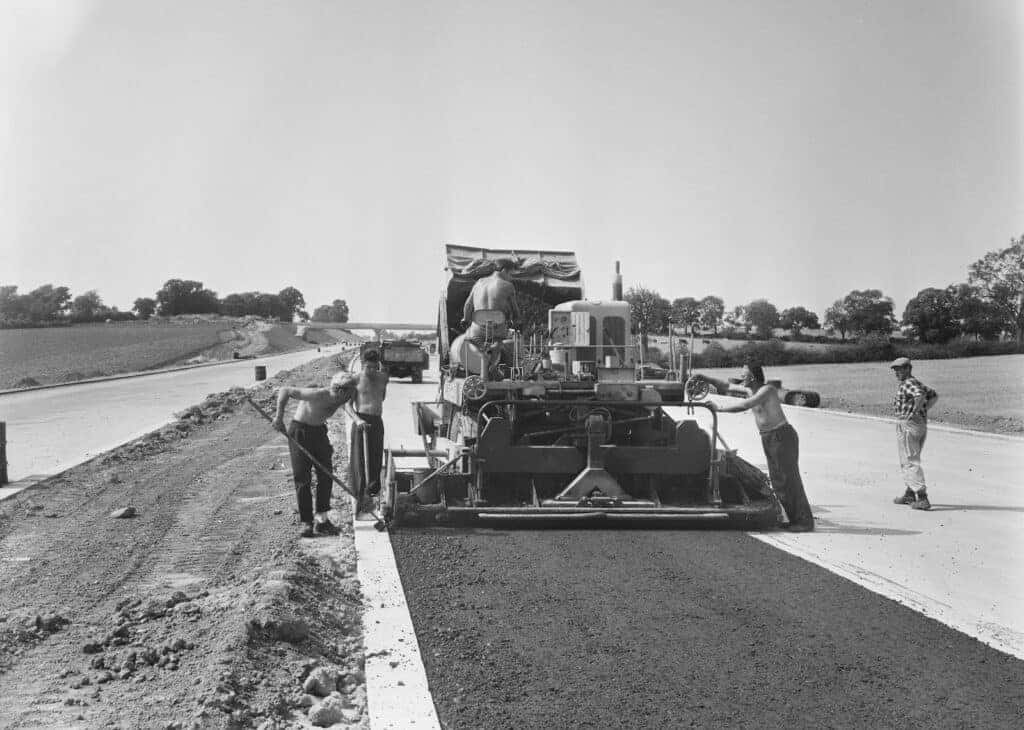
First used on Paris streets in 1824 and refined in the U.S. in the 1870s, asphalt created uniform surfaces that reduced vibration, noise, and maintenance. With fewer surface irregularities, vehicles could travel faster with less effort.
Asphalt didn’t just change how roads felt; it changed how drivers behaved.
At higher speeds, visual guidance became essential. Direction, predictability, and separation now mattered as much as firmness and drainage.
Paint, signs, and standardized layouts followed.
Why Cars Locked Everything in Place
Once automobiles arrived, road design and driving behavior became inseparable.
Cars couldn’t negotiate space informally the way carts had. They required:
- Predictable direction
- Consistent width
- Clear boundaries
- Visual guidance
Vehicles were built to match existing road behavior: left‑steering wheels in right‑drive countries, right‑steering in left‑drive countries. Changing road direction now meant rebuilding vehicles, retraining drivers, rewriting signage, and redesigning intersections.
The cost was enormous—and unnecessary.
Once a road system works, it stays.
Why All Roads Look Familiar Now
Modern roads look the way they do because they are the result of layered decisions, not a single plan:
- Camber exists because water destroys surfaces
- Lanes exist because speed requires separation
- Direction exists because vehicles need consistency
- Materials exist because use patterns demand durability
Every stripe, slope, and surface choice represents a solved problem from the past.
Roads are not neutral spaces. They are engineered compromises between physics, human behavior, and history.
Why the United States Drives on the Right
The United States didn’t choose right‑side driving by decree—it arrived there through use.
As American roads developed in the 18th century, they were dominated by large freight wagons, especially Conestoga wagons, used to move goods over long distances. Drivers typically controlled these wagons from the left side, either riding the left rear horse or walking alongside the wagon. From that position, keeping to the right side of the road made it easier to judge clearance, avoid obstacles, and pass oncoming traffic safely.
Right‑hand travel proved practical long before it was written into law. States eventually formalized what drivers were already doing, beginning with Pennsylvania in 1792 and New York in 1804. By the mid‑19th century, right‑side travel was standard across the country.
When automobiles arrived, they simply inherited this system. Vehicles were designed to match the road, not the other way around. Steering wheel placement, road markings, and traffic patterns all reinforced the existing flow.
The United States drives on the right because its roads evolved to serve the vehicles that used them—and once that system worked, it never needed to change.
Why It Still Matters at Mills Automotive Group
Vehicles are designed around roads, not the other way around. Steering geometry, braking behavior, driver‑assist systems, visibility standards, and even driver habits all assume a certain road shape, surface, and direction of travel.
Understanding why roads look the way they do—and why they flow the way they do—explains why modern vehicles behave as they do.
At Mills, being Trusted for Generations means recognizing that progress in mobility isn’t only about what’s under the hood. It’s also about the centuries of design decisions under the tires—decisions that shaped how we share space, move safely, and trust the road ahead.
Roads didn’t become what they are by accident.
They became what worked—and stayed that way.
Closing Scene…
…they straighten out onto a long stretch of pavement.
“So the road is helping us,” Bentley says. “Even when we don’t notice.”
Grandpa nods. “The best safety usually works that way.”
To be Continued…
 Chaudhary, Daksh. “Why Americans Drive on the Right-Hand Side (but Some Other Countries Don’t).” SlashGear, 15 July 2025, www.slashgear.com/1909565/why-americans-drive-right-side-road-history-explained/. Accessed 13 Apr. 2026.
Inventions , Mary Bellis Inventions Expert Mary Bellis covered, et al. “Follow the Evolution of the Road from Path to Pavement.” ThoughtCo, 29 Apr. 2025, www.thoughtco.com/history-of-roads-1992370.
Lee, Valerie Won. “How Ancient Roads Paved the Way for Modern Infrastructure: Lessons from Classical Engineering – Voices from History.” Voices from History, 30 Nov. 2024, voicesfromhistory.com/how-ancient-roads-paved-the-way-for-modern-infrastructure/.
The. “The History of How Roads Are Built, and What Future Construction May Look Like.” Going Places, 5 Aug. 2023, www.thegeneral.com/going-places/blog/car-and-driving-basics/the-history-of-how-roads-are-built-and-what-future-construction-may-look-like/.









0 comment(s) so far on It’s Worth the Drive – S2E2: The Road Beneath the Wheels