


It’s Worth the Drive – S1E6: The Second That Softened An Impact
Episode 6 – The Second That Softened An Impact
The Story Continues…
Another drive. Another errand.
Everything feels ordinary — traffic lights, crosswalks, parking lots. Nothing suggests that anything could go wrong.
And yet, folded quietly inside the car, something waits…
In the Passenger Compartment
Most drivers never see an airbag until the moment it matters most. Tucked behind steering wheels, dashboards, doors, seats, and rooflines, airbags remain invisible—quietly waiting. They do not announce themselves. They do not ask for attention.
Yet in the fraction of a second after a collision begins, they can change the outcome entirely.
Unlike other safety features that prevent accidents, airbags exist for what happens after everything else has failed.
An Idea Born From Sudden Silence
The idea behind the airbag predates most of the safety technology found in modern vehicles. In 1952, American engineer John W. Hetrick experienced a sudden stop that sent his car into a ditch. The crash was not severe, but it raised a question that would shape automotive safety for decades: could something deploy instantly to stop occupants from striking the interior of a vehicle?
In 1953, Hetrick received U.S. Patent No. 2,649,311 for a “Safety Cushion Assembly for Automotive Vehicles.” Around the same time, German inventor Walter Linderer developed a similar concept. Both designs relied on compressed air—an approach that proved too slow to be effective during real‑world collisions.
The idea was sound. The technology was not.
The Problem No One Could Solve—Yet
For years, airbag development stalled. The challenge was timing. In a crash, there are only milliseconds to react. Compressed gas systems could not inflate fast enough to provide meaningful protection.
The missing piece was a reliable crash sensor—one capable of detecting impact severity and triggering deployment instantly. That breakthrough came in the late 1960s from New Jersey inventor Allen K. Breed.
In 1968, Breed developed the first electromechanical crash sensor, creating the world’s first viable automotive airbag system. His invention solved the timing problem and became the foundation of modern airbag technology. At the birth of the airbag industry, Breed held the only practical sensing technology available.
The airbag was no longer theoretical.
From Experiment to Equipment
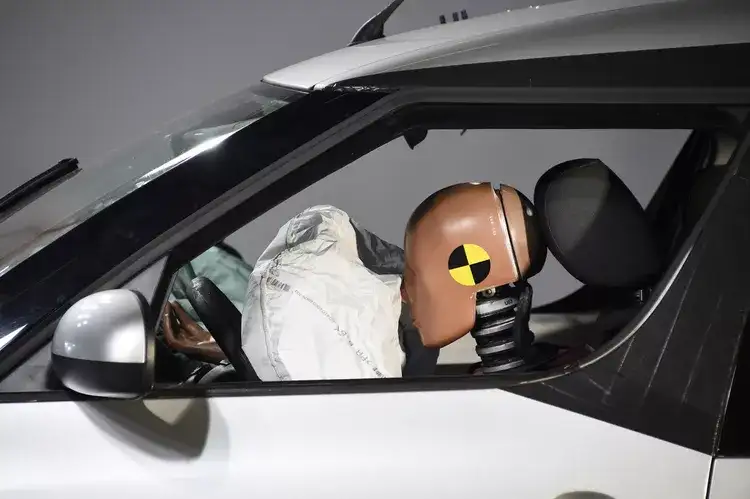
Automakers began testing airbags soon after. In 1971, Ford built an experimental airbag fleet. General Motors followed by installing airbags in a limited number of 1973 Chevrolet vehicles for government use. That same year, the Oldsmobile Toronado became the first production car sold to the public with a passenger‑side airbag.
Early systems, however, were far from perfect. Some caused serious injuries—and even fatalities—due to aggressive deployment and lack of occupant sensing. Consumer confidence faltered. Manufacturers hesitated.
By the mid‑1970s, airbags were offered as optional equipment on select models from GM and Cadillac, but adoption was limited. General Motors discontinued its “Air Cushion Restraint System” by 1977, citing lack of public interest.
The idea returned—but slowly.
Refinement, Regulation, and Acceptance
By the 1980s and early 1990s, advances in sensors, inflators, and materials dramatically improved airbag performance. Chrysler became the first manufacturer to offer driver‑side airbags as standard equipment in 1988, signaling a shift in industry confidence.
In 1994, TRW began producing the first modern gas‑inflated airbag systems. Data began to tell a compelling story. Airbags were working.
In 1998, the U.S. federal government mandated dual frontal airbags in all new passenger vehicles. What began as an experiment became a standard.
More Than One Cushion
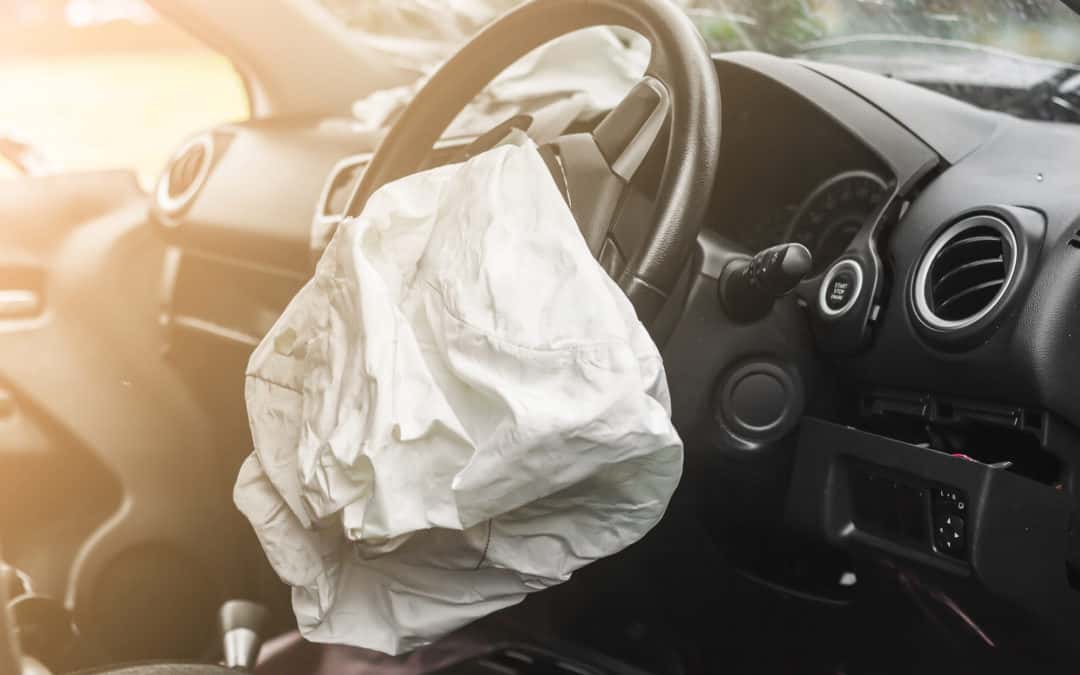
As understanding of crash dynamics grew, so did airbag variety. Today, vehicles may contain multiple types of airbags, each designed for a specific purpose:
- Frontal airbags, with advanced systems that adjust deployment force based on occupant size, seat position, seat belt use, and crash severity
- Side‑impact airbags, including torso, head, and curtain airbags designed to protect occupants during lateral collisions
- Knee airbags, which reduce leg injuries by preventing contact with dashboards
- Center airbags, which help prevent occupants from colliding with each other
- Inflatable seat belts, which spread crash forces over a wider area
Airbags evolved from a single cushion into a coordinated restraint system working alongside seat belts, sensors, and vehicle structure.
Measured in Lives, Not Features
Decades of data confirm the impact of this evolution. Research shows that frontal airbags reduce driver fatalities in frontal crashes by nearly 30%. Side airbags with head protection reduce the risk of death in side‑impact collisions by more than one‑third.
According to the National Highway Traffic Safety Administration, frontal airbags saved over 50,000 lives between 1987 and 2017. Thousands more are added every year.
The airbag does not prevent the crash. It softens the outcome.
What Comes Next
Modern development focuses on precision and prediction. New airbag designs account for angled impacts, multiple occupants, and even autonomous vehicle seating positions. Some manufacturers are exploring external airbags that deploy moments before impact to reduce crash severity.
As vehicles drive themselves more often, restraint systems will continue adapting—because the laws of physics remain unchanged.
Why It Still Matters at Mills Automotive Group
Airbags exist for the moment no driver ever plans for. They are not about convenience or visibility—they are about mitigating harm when a collision cannot be avoided. Their effectiveness depends on precise engineering, proper integration with seat belts and sensors, and correct operation at exactly the right time.
As airbag systems have evolved, they have become more intelligent and more interconnected. Modern vehicles rely on advanced sensors, occupant detection, and coordinated restraint systems to deploy airbags with the right amount of force, in the right situation, for the right occupant. When any part of that system is misunderstood, neglected, or improperly serviced, its ability to protect is compromised.
That is why airbags still matter at Mills.
Understanding how these systems work—and why they matter—helps ensure vehicles are trusted not just to perform, but to protect. Airbags are not features drivers interact with daily, but they are functions drivers depend on absolutely.
Being Trusted for Generations means respecting the purpose behind the technology, recognizing the responsibility that comes with it, and standing behind the safety systems designed to protect people when seconds matter most.
Closing Scene…
…the engine shuts off in the garage.
Nothing deployed. Nothing needed to.
Inside the vehicle, systems rest unseen, untouched, hoping they’ll never be noticed at all.
That’s the goal.
To be continued…
 Bellis, Mary. “Who Invented Airbags?” ThoughtCo, 9 Aug. 2019, www.thoughtco.com/history-of-airbags-1991232.
Bellis, Mary2, and The Inventors. “The History of Airbags.” Www.theinventors.org, 2006, www.theinventors.org/library/inventors/blair_bags.htm.
Blanco, Sebastian. “Donald Petersen, Former Ford Chairman and CEO, Dies at 97.” Car and Driver, 28 Apr. 2024, www.caranddriver.com/news/a60626538/don-petersen-former-ford-ceo-obituary/. Accessed 8 Apr. 2026.
Cullum, Leo, and Cartoonstock. “CartoonStock – Cartoon.” Cartoonstock.com, 2026, www.cartoonstock.com/cartoon?searchID=CX303356. Accessed 8 Apr. 2026.
Staff, DriveSafe Online. “Air Bags: Origins, Benefits, and the Future.” DriveSafe Online®, 3 Apr. 2020, www.drivesafeonline.org/traffic-school/air-bags-origins-benefits-and-the-future/.









0 comment(s) so far on It’s Worth the Drive – S1E6: The Second That Softened An Impact