


It’s Worth the Drive – S1E1: Strap in for Safety
Episode 1 – Strap in for Safety
Opening Scene…
The garage door lifts slowly, morning light spilling across the floor like it’s been there all night waiting.
The old man gets into the driver’s seat and closes the door behind him, the sound familiar, solid. He adjusts the mirror, not because it’s wrong, but because it’s a habit. His hand reaches across his chest without thought.
Click.
The seat belt settles into place, snug and unremarkable. Outside, the world is already moving. Inside, everything feels steady.
He turns the key and pulls forward.
The Beginning – Early Renditions
When it came to the seat belt, you might assume it was always intended for cars, but its origins actually lie in early aviation. In the late 19th century, English engineer George Cayley developed a simple lap belt for his monoplane glider to keep pilots secure during turbulent flights and rough landings.
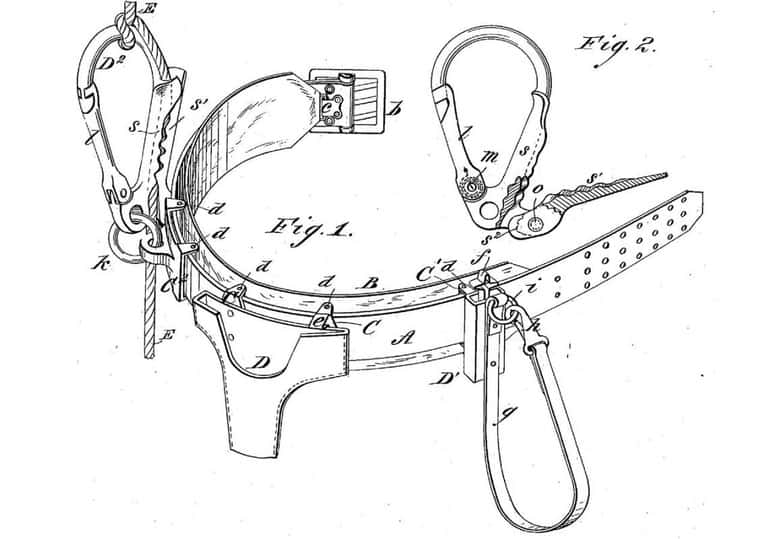
By 1885, the first U.S. patent for a “Safety Belt” was awarded to Edward J. Claghorn, whose design resembled a climbing harness more than a modern seat belt.
“The belt…of sufficient length to pass around the waist of the person using it…is provided at one of its ends with a buckle…” — Edward Claghorn
~Patent Pictured Below~
Enter the Automobile – The Mid‑20th Century
Throughout World War I and II, pilots relied on restraint systems, but everyday citizens had little exposure to seat belts until the automobile became widely available. Once Henry Ford standardized mass production, cars became accessible to the average American — but safety features lagged behind.
In 1949, Nash Motors Company in Wisconsin became the first to offer seat belts in their vehicles. Still, the public wasn’t convinced.
“Those belts were not popular, and neither was any design, for decades.” — Erin Breen, UNLV
The Concern for Safety
By the mid‑1950s, rising car accident rates pushed medical professionals to speak out. Neurologist Dr. C. Hunter Sheldon argued that seat belts could save lives — but only if people actually wore them. He advocated for improved designs and additional safety features like airbags, roll bars, and retractable belts.
Innovation accelerated:
- 1955: Roger Griswold and Hugh De Haven patented a combined shoulder‑and‑lap belt.
- 1958: Glen Sheren patented the “Sheren Safety Belt,” designed to keep car doors closed during crashes.
- 1959: Volvo engineer Nils Bohlin introduced the three‑point seat belt, the design still used today.
Bohlin’s design was simple, effective, and easy to use — securing the upper and lower body at the strongest points: shoulders, hips, and sternum. Volvo then made the patent available to all automakers for free, prioritizing public safety over profit.
Seat Belt vs. The People
Despite the clear benefits, many Americans resisted seat belts. Some found them uncomfortable; others felt they infringed on personal freedom.

A 1986 letter to The New York Times argued:
“A mandatory-seat-belt law violates the right to bodily privacy and self-control…”
But the data told a different story. Seat belts were saving lives — thousands of them.
Key milestones:
- 1966: Congress passed the National Traffic and Motor Vehicle Safety Act.
- 1968: All new American vehicles were required to include three‑point belts.
- 1984: New York became the first state to mandate seat belt use.
- 1994: Most states had adopted seat belt laws.
- 2023: Seat belt usage reached 91.9% nationwide.
“There are so many stories of how seat belts have saved thousands of lives…” — Erin Breen
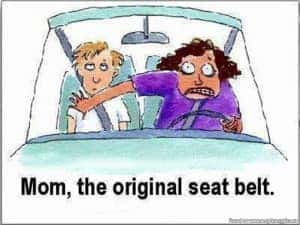 The Original Safety Feature – The Mom Arm Bar
Before seat belts became common — and long before they were required — there was one universal, unofficial safety measure: the mom arm bar.
For generations, parents perfected the lightning‑fast move of slamming on the brakes and simultaneously flinging an arm across the passenger seat. It didn’t matter if the passenger was a child, a teenager, or a full‑grown adult who weighed more than the parent — that arm was coming across.
Was it scientifically effective? Not even close.
Was it emotionally effective? Absolutely.
The mom arm bar became a cultural icon — a gesture that said, “I can stop a two‑ton vehicle with sheer parental willpower.” It was the original airbag, powered entirely by love, adrenaline, and a healthy dose of denial.
And while it couldn’t actually prevent injury in a real collision, it reminds us that before engineering caught up, safety often relied on instinct, care, and your mom’s arm.
Why It Still Matters to Mills Automotive Group
From a small garage with a hand‑turned wooden door to a multi‑location, community‑centered organization, Mills has grown alongside the automobile itself. Through every innovation and every mile traveled, one principle has never changed: taking care of the people behind the wheel.
Like seat belts, real safety isn’t flashy. It doesn’t boost performance or turn heads. It works quietly in the background, protecting people in moments they never planned for. That same philosophy guides Mills Automotive Group today.
Every vehicle sold represents more than transportation—it carries trust, responsibility, and a commitment to the communities Mills serves. Being Trusted for Generations means understanding that the fundamentals matter most. Safety doesn’t need to be loud to be effective. It needs to be dependable, built into every decision, every drive, every mile.
Because trust starts with the basics. And nothing is more fundamental than caring for the people inside the car.
Closing Scene…
…the road opens up ahead of him, smooth and predictable.
The seat belt does nothing at all.
No noise. No warning. No drama.
It simply stays where it belongs, holding him in place while the rest of the world keeps moving.
Some kinds of protection don’t ask for thanks.
They just stay with you.
To be continued…
“Tupac was one of the biggest thugs I know… and he ALWAYS wore his seat belt” – Ice Cube
Roth, Minhae Shim. “When Were Seat Belts Invented? | HISTORY.” HISTORY, 3 Oct. 2024, www.history.com/articles/who-invented-seat-belts.
Sheldon, Andrew. “A Seat Belt History Timeline.” Your AAA Network, AAA, 9 June 2021, magazine.northeast.aaa.com/daily/life/cars-trucks/auto-history/a-seat-belt-history-timeline/.









0 comment(s) so far on It’s Worth the Drive – S1E1: Strap in for Safety